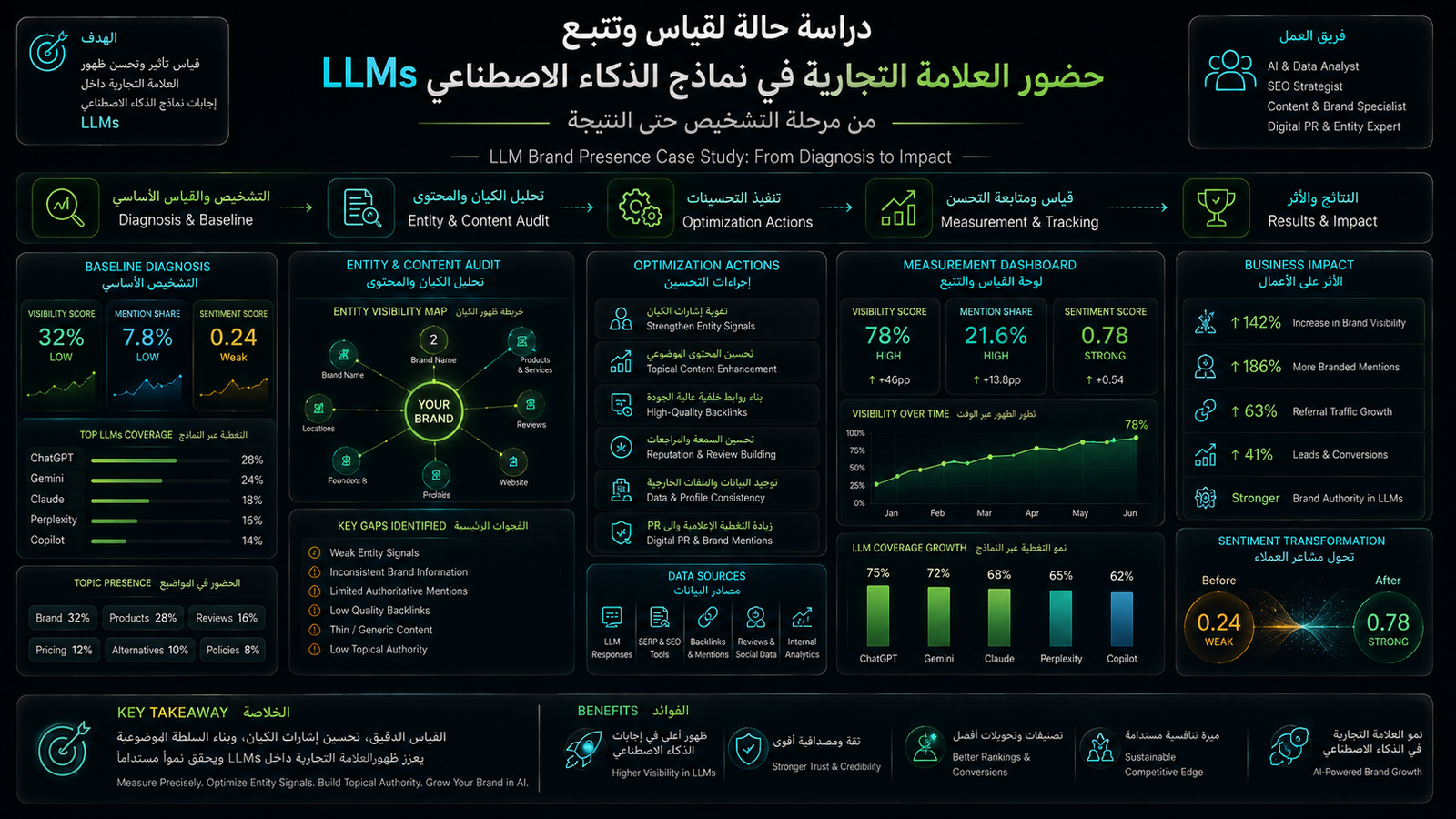
LLM Brand Visibility Measurement for Saudi Ecommerce and Service Businesses
قياس حضور العلامة في LLMs للمتاجر وشركات الخدمات السعودية: اختلاف الأولويات وخطة العمل. An expanded practical guide for improving visibility and attracting qualified customers.

Industry context changes questions, landing pages, trust signals, and buying cycles. A plan for a retailer cannot simply be copied to a service business.
Executive Answer
For “LLM Brand Visibility Measurement for Saudi Ecommerce and Service Businesses,” Start by defining the question the page must answer before selecting a keyword. A useful comparison explains differences in resources, risk, and expected outcomes instead of naming one universal winner. Local context matters because a company operating in Saudi Arabia may face different search language, buying cycles, and trust requirements than a generic international example suggests. Recommendations should therefore use site data, customer questions, and pages that create business value rather than a ready-made template. The practical output from this section is a decision that a marketing or development team can implement and review: a priority page, a defined question, a source to verify, an internal link, or a measurement experiment. If the output cannot be described that precisely, the information has not yet become an action plan. To keep the work testable, record the page title, target, visible queries, and unanswered customer questions before making changes. Assign an owner, review date, and acceptance criterion. These details prevent editorial activity from being confused with commercial progress and expose early whether the hypothesis fits a company in Saudi Arabia.
What Does the Service Mean?
For “LLM Brand Visibility Measurement for Saudi Ecommerce and Service Businesses,” Define the term and connect it to a business decision so the article does not become a generic glossary. A useful comparison explains differences in resources, risk, and expected outcomes instead of naming one universal winner. Local context matters because a company operating in Saudi Arabia may face different search language, buying cycles, and trust requirements than a generic international example suggests. Recommendations should therefore use site data, customer questions, and pages that create business value rather than a ready-made template. The practical output from this section is a decision that a marketing or development team can implement and review: a priority page, a defined question, a source to verify, an internal link, or a measurement experiment. If the output cannot be described that precisely, the information has not yet become an action plan. To keep the work testable, record the page title, target, visible queries, and unanswered customer questions before making changes. Assign an owner, review date, and acceptance criterion. These details prevent editorial activity from being confused with commercial progress and expose early whether the hypothesis fits a company in Saudi Arabia.
Why It Matters Now
For “LLM Brand Visibility Measurement for Saudi Ecommerce and Service Businesses,” List nearby questions and objections from sales conversations, then classify them by stage. A useful comparison explains differences in resources, risk, and expected outcomes instead of naming one universal winner. Local context matters because a company operating in Saudi Arabia may face different search language, buying cycles, and trust requirements than a generic international example suggests. Recommendations should therefore use site data, customer questions, and pages that create business value rather than a ready-made template. The practical output from this section is a decision that a marketing or development team can implement and review: a priority page, a defined question, a source to verify, an internal link, or a measurement experiment. If the output cannot be described that precisely, the information has not yet become an action plan. To keep the work testable, record the page title, target, visible queries, and unanswered customer questions before making changes. Assign an owner, review date, and acceptance criterion. These details prevent editorial activity from being confused with commercial progress and expose early whether the hypothesis fits a company in Saudi Arabia.
Search Intent and the Decision to Be Made
For “LLM Brand Visibility Measurement for Saudi Ecommerce and Service Businesses,” Check crawling, indexing, and links before assuming the problem is only the prose. A useful comparison explains differences in resources, risk, and expected outcomes instead of naming one universal winner. Local context matters because a company operating in Saudi Arabia may face different search language, buying cycles, and trust requirements than a generic international example suggests. Recommendations should therefore use site data, customer questions, and pages that create business value rather than a ready-made template. The practical output from this section is a decision that a marketing or development team can implement and review: a priority page, a defined question, a source to verify, an internal link, or a measurement experiment. If the output cannot be described that precisely, the information has not yet become an action plan. To keep the work testable, record the page title, target, visible queries, and unanswered customer questions before making changes. Assign an owner, review date, and acceptance criterion. These details prevent editorial activity from being confused with commercial progress and expose early whether the hypothesis fits a company in Saudi Arabia.
How the Diagnosis Starts
For “LLM Brand Visibility Measurement for Saudi Ecommerce and Service Businesses,” Use an entity map that connects the brand, services, people, and markets to evidence. A useful comparison explains differences in resources, risk, and expected outcomes instead of naming one universal winner. Local context matters because a company operating in Saudi Arabia may face different search language, buying cycles, and trust requirements than a generic international example suggests. Recommendations should therefore use site data, customer questions, and pages that create business value rather than a ready-made template. The practical output from this section is a decision that a marketing or development team can implement and review: a priority page, a defined question, a source to verify, an internal link, or a measurement experiment. If the output cannot be described that precisely, the information has not yet become an action plan. To keep the work testable, record the page title, target, visible queries, and unanswered customer questions before making changes. Assign an owner, review date, and acceptance criterion. These details prevent editorial activity from being confused with commercial progress and expose early whether the hypothesis fits a company in Saudi Arabia.
Content, Entity, and Source Mapping
For “LLM Brand Visibility Measurement for Saudi Ecommerce and Service Businesses,” Write a direct answer first, then add the detail that explains exceptions and limits. A useful comparison explains differences in resources, risk, and expected outcomes instead of naming one universal winner. Local context matters because a company operating in Saudi Arabia may face different search language, buying cycles, and trust requirements than a generic international example suggests. Recommendations should therefore use site data, customer questions, and pages that create business value rather than a ready-made template. The practical output from this section is a decision that a marketing or development team can implement and review: a priority page, a defined question, a source to verify, an internal link, or a measurement experiment. If the output cannot be described that precisely, the information has not yet become an action plan. To keep the work testable, record the page title, target, visible queries, and unanswered customer questions before making changes. Assign an owner, review date, and acceptance criterion. These details prevent editorial activity from being confused with commercial progress and expose early whether the hypothesis fits a company in Saudi Arabia.
Writing Answers Search Systems Can Understand
For “LLM Brand Visibility Measurement for Saudi Ecommerce and Service Businesses,” Give each commercial page one job: educate, compare, qualify, or create a contact opportunity. A useful comparison explains differences in resources, risk, and expected outcomes instead of naming one universal winner. Local context matters because a company operating in Saudi Arabia may face different search language, buying cycles, and trust requirements than a generic international example suggests. Recommendations should therefore use site data, customer questions, and pages that create business value rather than a ready-made template. The practical output from this section is a decision that a marketing or development team can implement and review: a priority page, a defined question, a source to verify, an internal link, or a measurement experiment. If the output cannot be described that precisely, the information has not yet become an action plan. To keep the work testable, record the page title, target, visible queries, and unanswered customer questions before making changes. Assign an owner, review date, and acceptance criterion. These details prevent editorial activity from being confused with commercial progress and expose early whether the hypothesis fits a company in Saudi Arabia.
Improving Commercial Pages Without Padding
For “LLM Brand Visibility Measurement for Saudi Ecommerce and Service Businesses,” Link to the service page when the reader needs implementation, not simply to increase link count. A useful comparison explains differences in resources, risk, and expected outcomes instead of naming one universal winner. Local context matters because a company operating in Saudi Arabia may face different search language, buying cycles, and trust requirements than a generic international example suggests. Recommendations should therefore use site data, customer questions, and pages that create business value rather than a ready-made template. The practical output from this section is a decision that a marketing or development team can implement and review: a priority page, a defined question, a source to verify, an internal link, or a measurement experiment. If the output cannot be described that precisely, the information has not yet become an action plan. To keep the work testable, record the page title, target, visible queries, and unanswered customer questions before making changes. Assign an owner, review date, and acceptance criterion. These details prevent editorial activity from being confused with commercial progress and expose early whether the hypothesis fits a company in Saudi Arabia.
Connecting SEO, AEO, and GEO
For “LLM Brand Visibility Measurement for Saudi Ecommerce and Service Businesses,” Treat SEO as the eligibility and understanding layer, AEO as answer structure, and GEO as signal and source management. A useful comparison explains differences in resources, risk, and expected outcomes instead of naming one universal winner. Local context matters because a company operating in Saudi Arabia may face different search language, buying cycles, and trust requirements than a generic international example suggests. Recommendations should therefore use site data, customer questions, and pages that create business value rather than a ready-made template. The practical output from this section is a decision that a marketing or development team can implement and review: a priority page, a defined question, a source to verify, an internal link, or a measurement experiment. If the output cannot be described that precisely, the information has not yet become an action plan. To keep the work testable, record the page title, target, visible queries, and unanswered customer questions before making changes. Assign an owner, review date, and acceptance criterion. These details prevent editorial activity from being confused with commercial progress and expose early whether the hypothesis fits a company in Saudi Arabia.
Structured Data and Technical Clarity
For “LLM Brand Visibility Measurement for Saudi Ecommerce and Service Businesses,” Do not use Schema to claim information that users cannot see or that the business cannot support. A useful comparison explains differences in resources, risk, and expected outcomes instead of naming one universal winner. Local context matters because a company operating in Saudi Arabia may face different search language, buying cycles, and trust requirements than a generic international example suggests. Recommendations should therefore use site data, customer questions, and pages that create business value rather than a ready-made template. The practical output from this section is a decision that a marketing or development team can implement and review: a priority page, a defined question, a source to verify, an internal link, or a measurement experiment. If the output cannot be described that precisely, the information has not yet become an action plan. To keep the work testable, record the page title, target, visible queries, and unanswered customer questions before making changes. Assign an owner, review date, and acceptance criterion. These details prevent editorial activity from being confused with commercial progress and expose early whether the hypothesis fits a company in Saudi Arabia.
Trust and Expertise Signals
For “LLM Brand Visibility Measurement for Saudi Ecommerce and Service Businesses,” Show expertise through an explainable method, specific examples, and human review of sensitive information. A useful comparison explains differences in resources, risk, and expected outcomes instead of naming one universal winner. Local context matters because a company operating in Saudi Arabia may face different search language, buying cycles, and trust requirements than a generic international example suggests. Recommendations should therefore use site data, customer questions, and pages that create business value rather than a ready-made template. The practical output from this section is a decision that a marketing or development team can implement and review: a priority page, a defined question, a source to verify, an internal link, or a measurement experiment. If the output cannot be described that precisely, the information has not yet become an action plan. To keep the work testable, record the page title, target, visible queries, and unanswered customer questions before making changes. Assign an owner, review date, and acceptance criterion. These details prevent editorial activity from being confused with commercial progress and expose early whether the hypothesis fits a company in Saudi Arabia.
Localization by Market and Language
For “LLM Brand Visibility Measurement for Saudi Ecommerce and Service Businesses,” Rewrite examples for Saudi Arabia; do not create a country or city page that adds no real value. A useful comparison explains differences in resources, risk, and expected outcomes instead of naming one universal winner. Local context matters because a company operating in Saudi Arabia may face different search language, buying cycles, and trust requirements than a generic international example suggests. Recommendations should therefore use site data, customer questions, and pages that create business value rather than a ready-made template. The practical output from this section is a decision that a marketing or development team can implement and review: a priority page, a defined question, a source to verify, an internal link, or a measurement experiment. If the output cannot be described that precisely, the information has not yet become an action plan. To keep the work testable, record the page title, target, visible queries, and unanswered customer questions before making changes. Assign an owner, review date, and acceptance criterion. These details prevent editorial activity from being confused with commercial progress and expose early whether the hypothesis fits a company in Saudi Arabia.
A Practical Ecommerce or Service-Business Example
For “LLM Brand Visibility Measurement for Saudi Ecommerce and Service Businesses,” Test the scenario for a service company and a retailer because their questions and buying journeys differ. A useful comparison explains differences in resources, risk, and expected outcomes instead of naming one universal winner. Local context matters because a company operating in Saudi Arabia may face different search language, buying cycles, and trust requirements than a generic international example suggests. Recommendations should therefore use site data, customer questions, and pages that create business value rather than a ready-made template. The practical output from this section is a decision that a marketing or development team can implement and review: a priority page, a defined question, a source to verify, an internal link, or a measurement experiment. If the output cannot be described that precisely, the information has not yet become an action plan. To keep the work testable, record the page title, target, visible queries, and unanswered customer questions before making changes. Assign an owner, review date, and acceptance criterion. These details prevent editorial activity from being confused with commercial progress and expose early whether the hypothesis fits a company in Saudi Arabia.
What the Client Should Receive
For “LLM Brand Visibility Measurement for Saudi Ecommerce and Service Businesses,” Define deliverables as files, maps, or implementation tickets rather than vague promises. A useful comparison explains differences in resources, risk, and expected outcomes instead of naming one universal winner. Local context matters because a company operating in Saudi Arabia may face different search language, buying cycles, and trust requirements than a generic international example suggests. Recommendations should therefore use site data, customer questions, and pages that create business value rather than a ready-made template. The practical output from this section is a decision that a marketing or development team can implement and review: a priority page, a defined question, a source to verify, an internal link, or a measurement experiment. If the output cannot be described that precisely, the information has not yet become an action plan. To keep the work testable, record the page title, target, visible queries, and unanswered customer questions before making changes. Assign an owner, review date, and acceptance criterion. These details prevent editorial activity from being confused with commercial progress and expose early whether the hypothesis fits a company in Saudi Arabia.
Cost, Return, and Expectation Setting
For “LLM Brand Visibility Measurement for Saudi Ecommerce and Service Businesses,” Connect cost to time, scope, market count, and implementation level instead of presenting an unsupported number. A useful comparison explains differences in resources, risk, and expected outcomes instead of naming one universal winner. Local context matters because a company operating in Saudi Arabia may face different search language, buying cycles, and trust requirements than a generic international example suggests. Recommendations should therefore use site data, customer questions, and pages that create business value rather than a ready-made template. The practical output from this section is a decision that a marketing or development team can implement and review: a priority page, a defined question, a source to verify, an internal link, or a measurement experiment. If the output cannot be described that precisely, the information has not yet become an action plan. To keep the work testable, record the page title, target, visible queries, and unanswered customer questions before making changes. Assign an owner, review date, and acceptance criterion. These details prevent editorial activity from being confused with commercial progress and expose early whether the hypothesis fits a company in Saudi Arabia.
Metrics and the Reporting Dashboard
For “LLM Brand Visibility Measurement for Saudi Ecommerce and Service Businesses,” Track queries, clicks, assisted visits, and lead quality in one reporting model where possible. A useful comparison explains differences in resources, risk, and expected outcomes instead of naming one universal winner. Local context matters because a company operating in Saudi Arabia may face different search language, buying cycles, and trust requirements than a generic international example suggests. Recommendations should therefore use site data, customer questions, and pages that create business value rather than a ready-made template. The practical output from this section is a decision that a marketing or development team can implement and review: a priority page, a defined question, a source to verify, an internal link, or a measurement experiment. If the output cannot be described that precisely, the information has not yet become an action plan. To keep the work testable, record the page title, target, visible queries, and unanswered customer questions before making changes. Assign an owner, review date, and acceptance criterion. These details prevent editorial activity from being confused with commercial progress and expose early whether the hypothesis fits a company in Saudi Arabia.
Mistakes That Weaken the Outcome
For “LLM Brand Visibility Measurement for Saudi Ecommerce and Service Businesses,” Avoid keyword stuffing, competitor copying, and near-duplicate pages that only change the country name. A useful comparison explains differences in resources, risk, and expected outcomes instead of naming one universal winner. Local context matters because a company operating in Saudi Arabia may face different search language, buying cycles, and trust requirements than a generic international example suggests. Recommendations should therefore use site data, customer questions, and pages that create business value rather than a ready-made template. The practical output from this section is a decision that a marketing or development team can implement and review: a priority page, a defined question, a source to verify, an internal link, or a measurement experiment. If the output cannot be described that precisely, the information has not yet become an action plan. To keep the work testable, record the page title, target, visible queries, and unanswered customer questions before making changes. Assign an owner, review date, and acceptance criterion. These details prevent editorial activity from being confused with commercial progress and expose early whether the hypothesis fits a company in Saudi Arabia.
A Practical 90-Day Implementation Plan
For “LLM Brand Visibility Measurement for Saudi Ecommerce and Service Businesses,” Divide the first 90 days into diagnosis, implementation, and learning with a defined review point. A useful comparison explains differences in resources, risk, and expected outcomes instead of naming one universal winner. Local context matters because a company operating in Saudi Arabia may face different search language, buying cycles, and trust requirements than a generic international example suggests. Recommendations should therefore use site data, customer questions, and pages that create business value rather than a ready-made template. The practical output from this section is a decision that a marketing or development team can implement and review: a priority page, a defined question, a source to verify, an internal link, or a measurement experiment. If the output cannot be described that precisely, the information has not yet become an action plan. To keep the work testable, record the page title, target, visible queries, and unanswered customer questions before making changes. Assign an owner, review date, and acceptance criterion. These details prevent editorial activity from being confused with commercial progress and expose early whether the hypothesis fits a company in Saudi Arabia.
How to Choose a Provider
For “LLM Brand Visibility Measurement for Saudi Ecommerce and Service Businesses,” Ask a provider to explain what its team will do, what it needs from you, and what it will not guarantee. A useful comparison explains differences in resources, risk, and expected outcomes instead of naming one universal winner. Local context matters because a company operating in Saudi Arabia may face different search language, buying cycles, and trust requirements than a generic international example suggests. Recommendations should therefore use site data, customer questions, and pages that create business value rather than a ready-made template. The practical output from this section is a decision that a marketing or development team can implement and review: a priority page, a defined question, a source to verify, an internal link, or a measurement experiment. If the output cannot be described that precisely, the information has not yet become an action plan. To keep the work testable, record the page title, target, visible queries, and unanswered customer questions before making changes. Assign an owner, review date, and acceptance criterion. These details prevent editorial activity from being confused with commercial progress and expose early whether the hypothesis fits a company in Saudi Arabia.
Conclusion
For “LLM Brand Visibility Measurement for Saudi Ecommerce and Service Businesses,” End with a small actionable step such as an initial review or diagnostic call connected to the service. A useful comparison explains differences in resources, risk, and expected outcomes instead of naming one universal winner. Local context matters because a company operating in Saudi Arabia may face different search language, buying cycles, and trust requirements than a generic international example suggests. Recommendations should therefore use site data, customer questions, and pages that create business value rather than a ready-made template. The practical output from this section is a decision that a marketing or development team can implement and review: a priority page, a defined question, a source to verify, an internal link, or a measurement experiment. If the output cannot be described that precisely, the information has not yet become an action plan. To keep the work testable, record the page title, target, visible queries, and unanswered customer questions before making changes. Assign an owner, review date, and acceptance criterion. These details prevent editorial activity from being confused with commercial progress and expose early whether the hypothesis fits a company in Saudi Arabia.