SEO vs AEO vs GEO: Differences and a Unified Strategy
Think SEO, AEO, and GEO are three separate strategies you need to run at once? The reality may be much simpler. Discover how these approaches work together to build one unified search strategy that improves visibility, delivers better answers, and strengthens your brand presence across modern search experiences.
Before choosing an acronym, understand the query and the page that will answer it
SEO vs AEO vs GEO: Differences and a Unified Strategy
Independent English edition | ART-28 | Cluster: AI Search, GEO and AEO | Intent: Informational awareness
English SEO Data
SEO Title: SEO vs AEO vs GEO: Building One Unified Search Strategy
Meta Description: Understand SEO, AEO and GEO, when each matters, and how to build one measurable strategy for content, entities, indexation and AI visibility for brands today.
Slug: seo-aeo-geo-guide
Primary Keyword: SEO vs AEO vs GEO
CTA: Build a unified search strategy: +20 112 326 9452
SEO, AEO and GEO are often presented as three separate services that every brand must run at once. Searchers do not care about the acronyms; they need a useful answer, product or service page. This article explains the practical difference, what Google actually recommends and how one connected strategy can support traditional search, answer experiences and generative visibility.
Need to decide which part of your search strategy should come first? Contact Mohamed Yahia: +20 112 326 9452 |
Contents
Definitions • Intent • AEO and GEO • Entities • Content • Local and ecommerce use cases • Measurement • Unified workflow • Mistakes and checklist
SEO vs AEO vs GEO
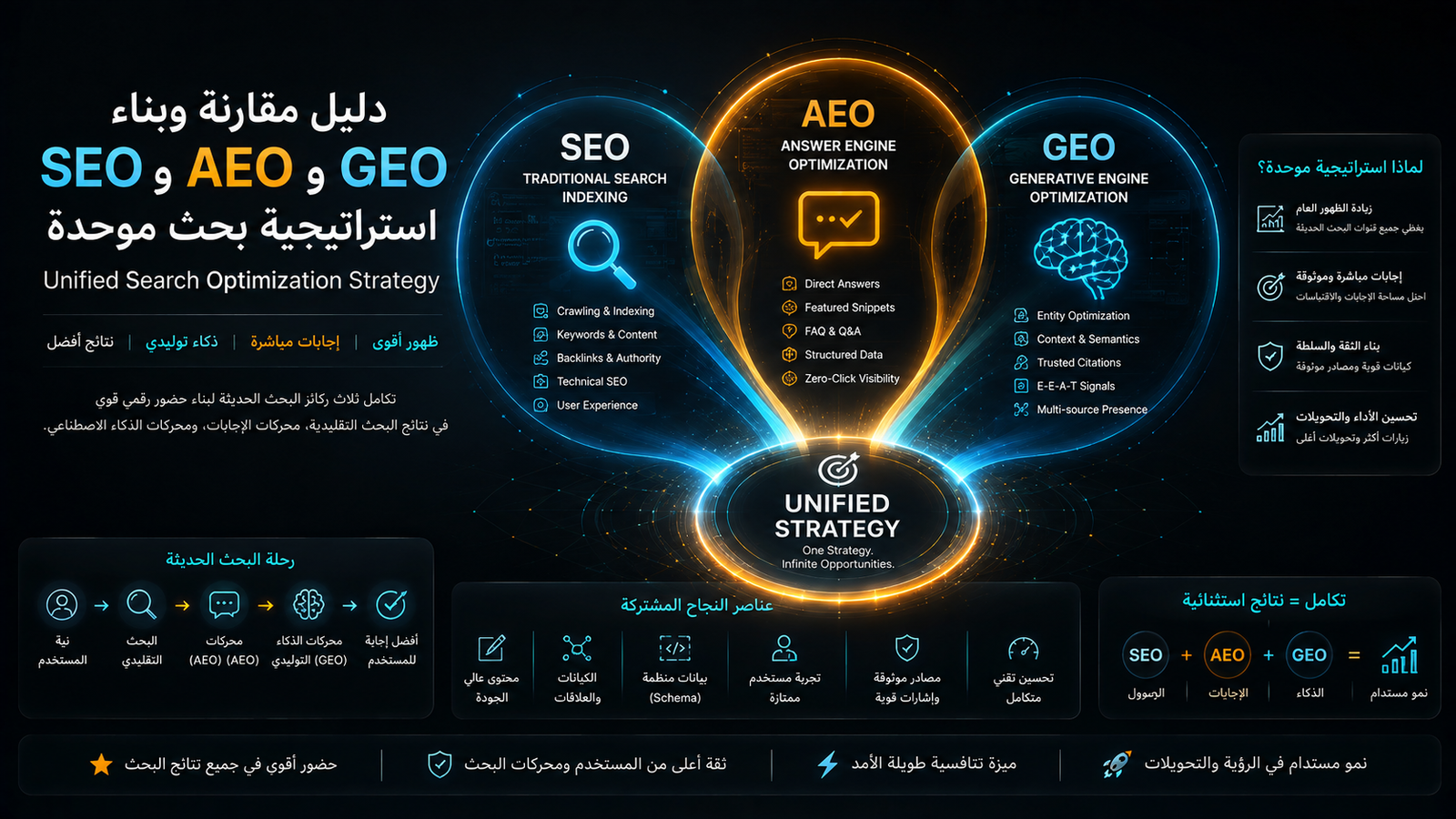
SEO is the broad discipline of improving a site’s visibility through crawling, indexation, content, links and page experience. AEO focuses on answering questions clearly in answer-oriented results. GEO is commonly used to describe improving brand and content visibility in generative search experiences. They can support one another; none replaces the foundation.
Practical action: Start with a page sample, record the baseline, release the change in a controlled group and monitor visibility, clicks and conversion.
Why You Do Not Need Three Separate Campaigns
Planning labels can be useful, but execution relies on shared assets: a helpful page, clear entities, sound links, trusted evidence and a good experience. Three disconnected campaigns often create duplicated content and conflicting messages. Start with a search and business objective, then decide whether the constraint is content, architecture, identity or measurement.
Practical action: Start with a page sample, record the baseline, release the change in a controlled group and monitor visibility, clicks and conversion.
What Google Actually Recommends
Google’s current guidance continues to emphasise SEO fundamentals and helpful content for generative search features. There is no guaranteed tactic called GEO or AEO. A page still needs to be crawlable, indexable, original and useful with a strong experience. A responsible strategy should explain this rather than sell a secret formula.
Practical action: Start with a page sample, record the baseline, release the change in a controlled group and monitor visibility, clicks and conversion.
Start with Intent
Decide whether the user wants an answer, comparison, service, product or solution. Assign the right page type to the intent and build a logical bridge to the CTA. Search intent determines the title, questions, examples and next action; the acronym does not.
Practical action: Start with a page sample, record the baseline, release the change in a controlled group and monitor visibility, clicks and conversion.
AEO: Make Answers Understandable
Lead with a direct answer, then add reasoning, steps and exceptions. Use question headings and lists when they improve comprehension. Do not repeat the query mechanically or hide the answer. A useful answer remains valuable even when no special snippet or generated answer appears.
Practical action: Start with a page sample, record the baseline, release the change in a controlled group and monitor visibility, clicks and conversion.
GEO: Make the Brand Understandable
Explain who you are, what you provide, who it is for, where you operate and what evidence supports your expertise. Keep names, roles, links and services consistent across the site and credible profiles. GEO is not repeating a brand name; it is building verifiable information and relationships.
Practical action: Start with a page sample, record the baseline, release the change in a controlled group and monitor visibility, clicks and conversion.
Entities and Relationships
Connect a person to a service, a service to a problem and industry, and an article to the page that delivers the work. Include alternate terms, markets and languages where they help the reader. Useful relationships make a site easier for both users and systems that assemble answers.
Practical action: Start with a page sample, record the baseline, release the change in a controlled group and monitor visibility, clicks and conversion.
Original Experience and Evidence
Use practical experience, clear examples and honest limits. Label illustrative examples. Use client results only with permission and evidence. Content that helps a reader make or test a decision is stronger than a generic rewrite of definitions already available elsewhere.
Practical action: Start with a page sample, record the baseline, release the change in a controlled group and monitor visibility, clicks and conversion.
Is llms.txt Required?
Do not treat unofficial files or tools as requirements for visibility. Prioritise crawlable pages, helpful content, links and page experience. Add any technical file only when it solves a documented problem, not because a trend makes it sound mandatory.
Practical action: Start with a page sample, record the baseline, release the change in a controlled group and monitor visibility, clicks and conversion.
AI-Assisted Content
The production tool is not the quality standard. Review facts, privacy, originality, experience and usefulness, and add value that generic text cannot provide. Large-scale automated publishing with minor wording changes can create low-value pages and consume editorial resources without building authority.
Practical action: Start with a page sample, record the baseline, release the change in a controlled group and monitor visibility, clicks and conversion.
Local Search
Mention a city or country when a real service and useful local information exist. Do not create identical pages for Saudi Arabia, the UAE and Iraq by swapping names. Explain service scope, local terms and practical questions, then connect the page to a usable contact path.
Practical action: Start with a page sample, record the baseline, release the change in a controlled group and monitor visibility, clicks and conversion.
Ecommerce Applications
Collection and product pages should answer selection questions and keep price, stock and delivery information accurate. AEO cannot repair a weak product page, and GEO cannot compensate for faceted duplication or poor indexation. Link educational content to the commercial page at the decision point.
Practical action: Start with a page sample, record the baseline, release the change in a controlled group and monitor visibility, clicks and conversion.
Visual and Voice Search
Images and video support understanding, but essential information should not exist only inside an image. Use descriptive alt text, accessible media and fast loading. Voice queries benefit from natural answers and local context, but they still need a complete page behind the answer.
Practical action: Start with a page sample, record the baseline, release the change in a controlled group and monitor visibility, clicks and conversion.
Internal Linking
Connect a hub to supporting articles and the service page, and link an article to the relevant product or commercial destination. Use descriptive anchor text and update old links. Internal links aid discovery and explain relationships; they are not a place to stuff terms.
Practical action: Start with a page sample, record the baseline, release the change in a controlled group and monitor visibility, clicks and conversion.
Measurement
Create a query set for languages, markets and funnel stages. Record visibility, mentions, source, clicks and conversion, then compare Search Console, analytics and branded demand. Do not judge GEO by the number of times a brand appeared in one test experience.
Practical action: Start with a page sample, record the baseline, release the change in a controlled group and monitor visibility, clicks and conversion.
Search Console Reporting
Use available Search Console reports to understand pages, queries and changes after updates. Compare page groups instead of one keyword. Every decision should have a page, a purpose and a metric rather than being driven by a quick impression.
Practical action: Start with a page sample, record the baseline, release the change in a controlled group and monitor visibility, clicks and conversion.
External References
A mention in a relevant trusted source may improve brand understanding, but random paid mentions and copied guest content are not a strategy. Contribute evidence or useful commentary and choose sources with genuine topical and market relevance.
Practical action: Start with a page sample, record the baseline, release the change in a controlled group and monitor visibility, clicks and conversion.
One Unified Workflow
Start with an SEO audit, then map intent, questions and entities; improve priority pages; add useful supporting content and references; and measure visibility and business outcomes. This is one connected cycle, not three unrelated campaigns.
Practical action: Start with a page sample, record the baseline, release the change in a controlled group and monitor visibility, clicks and conversion.
Common Mistakes
Stuffing SEO, AEO and GEO into headings, publishing thin pages, guaranteeing inclusion, unsupported examples, incomplete translations, ignored indexation and one-prompt measurement are common failures. Clarity, consistency, testing and human review are the remedy.
Practical action: Start with a page sample, record the baseline, release the change in a controlled group and monitor visibility, clicks and conversion.
When to Hire a Specialist
Request a specialist review when you want to enter AI Search or combine local and commercial growth, or when you do not know which pages and questions to prioritise. Mohamed Yahia can build a realistic decision map. Contact +20 112 326 9452.
Practical action: Start with a page sample, record the baseline, release the change in a controlled group and monitor visibility, clicks and conversion.
A 90-Day Plan
Use weeks one and two for inventory, intent, entities and measurement. Improve priority pages and hubs in weeks three to six. Add evidence, references and local content in weeks seven to ten. Use the final two weeks to review visibility and conversion and reset priorities.
Practical action: Start with a page sample, record the baseline, release the change in a controlled group and monitor visibility, clicks and conversion.
Conclusion
SEO, AEO and GEO describe overlapping objectives within one system. Build a crawlable site, helpful content and a clear entity, then measure outcomes realistically. For a unified strategy, contact Mohamed Yahia on WhatsApp at +20 112 326 9452.
Practical action: Start with a page sample, record the baseline, release the change in a controlled group and monitor visibility, clicks and conversion.
Execution Audit
Use these checks to set priorities rather than create endless tasks. Review query, page, entity and business goal together, then implement what can be measured.
Audit 1: SEO vs AEO vs GEO
Review a representative sample related to SEO vs AEO vs GEO. Record queries, page type, links, visibility and source. Confirm that the answer is clear and the page remains crawlable and useful.
Turn the observation into a hypothesis, document the version and date, then compare Search Console, analytics and conversions. Do not rely on one appearance or an unsupported promise.
Audit 2: Why You Do Not Need Three Separate Campaigns
Review a representative sample related to Why You Do Not Need Three Separate Campaigns. Record queries, page type, links, visibility and source. Confirm that the answer is clear and the page remains crawlable and useful.
Turn the observation into a hypothesis, document the version and date, then compare Search Console, analytics and conversions. Do not rely on one appearance or an unsupported promise.
Audit 3: What Google Actually Recommends
Review a representative sample related to What Google Actually Recommends. Record queries, page type, links, visibility and source. Confirm that the answer is clear and the page remains crawlable and useful.
Turn the observation into a hypothesis, document the version and date, then compare Search Console, analytics and conversions. Do not rely on one appearance or an unsupported promise.
Audit 4: Start with Intent
Review a representative sample related to Start with Intent. Record queries, page type, links, visibility and source. Confirm that the answer is clear and the page remains crawlable and useful.
Turn the observation into a hypothesis, document the version and date, then compare Search Console, analytics and conversions. Do not rely on one appearance or an unsupported promise.
Audit 5: AEO: Make Answers Understandable
Review a representative sample related to AEO: Make Answers Understandable. Record queries, page type, links, visibility and source. Confirm that the answer is clear and the page remains crawlable and useful.
Turn the observation into a hypothesis, document the version and date, then compare Search Console, analytics and conversions. Do not rely on one appearance or an unsupported promise.
Audit 6: GEO: Make the Brand Understandable
Review a representative sample related to GEO: Make the Brand Understandable. Record queries, page type, links, visibility and source. Confirm that the answer is clear and the page remains crawlable and useful.
Turn the observation into a hypothesis, document the version and date, then compare Search Console, analytics and conversions. Do not rely on one appearance or an unsupported promise.
Audit 7: Entities and Relationships
Review a representative sample related to Entities and Relationships. Record queries, page type, links, visibility and source. Confirm that the answer is clear and the page remains crawlable and useful.
Turn the observation into a hypothesis, document the version and date, then compare Search Console, analytics and conversions. Do not rely on one appearance or an unsupported promise.
Audit 8: Original Experience and Evidence
Review a representative sample related to Original Experience and Evidence. Record queries, page type, links, visibility and source. Confirm that the answer is clear and the page remains crawlable and useful.
Turn the observation into a hypothesis, document the version and date, then compare Search Console, analytics and conversions. Do not rely on one appearance or an unsupported promise.
Audit 9: Is llms.txt Required?
Review a representative sample related to Is llms.txt Required?. Record queries, page type, links, visibility and source. Confirm that the answer is clear and the page remains crawlable and useful.
Turn the observation into a hypothesis, document the version and date, then compare Search Console, analytics and conversions. Do not rely on one appearance or an unsupported promise.
Audit 10: AI-Assisted Content
Review a representative sample related to AI-Assisted Content. Record queries, page type, links, visibility and source. Confirm that the answer is clear and the page remains crawlable and useful.
Turn the observation into a hypothesis, document the version and date, then compare Search Console, analytics and conversions. Do not rely on one appearance or an unsupported promise.
Audit 11: Local Search
Review a representative sample related to Local Search. Record queries, page type, links, visibility and source. Confirm that the answer is clear and the page remains crawlable and useful.
Turn the observation into a hypothesis, document the version and date, then compare Search Console, analytics and conversions. Do not rely on one appearance or an unsupported promise.
Audit 12: Ecommerce Applications
Review a representative sample related to Ecommerce Applications. Record queries, page type, links, visibility and source. Confirm that the answer is clear and the page remains crawlable and useful.
Turn the observation into a hypothesis, document the version and date, then compare Search Console, analytics and conversions. Do not rely on one appearance or an unsupported promise.
Audit 13: Visual and Voice Search
Review a representative sample related to Visual and Voice Search. Record queries, page type, links, visibility and source. Confirm that the answer is clear and the page remains crawlable and useful.
Turn the observation into a hypothesis, document the version and date, then compare Search Console, analytics and conversions. Do not rely on one appearance or an unsupported promise.
Audit 14: Internal Linking
Review a representative sample related to Internal Linking. Record queries, page type, links, visibility and source. Confirm that the answer is clear and the page remains crawlable and useful.
Turn the observation into a hypothesis, document the version and date, then compare Search Console, analytics and conversions. Do not rely on one appearance or an unsupported promise.
Audit 15: Measurement
Review a representative sample related to Measurement. Record queries, page type, links, visibility and source. Confirm that the answer is clear and the page remains crawlable and useful.
Turn the observation into a hypothesis, document the version and date, then compare Search Console, analytics and conversions. Do not rely on one appearance or an unsupported promise.
Audit 16: Search Console Reporting
Review a representative sample related to Search Console Reporting. Record queries, page type, links, visibility and source. Confirm that the answer is clear and the page remains crawlable and useful.
Turn the observation into a hypothesis, document the version and date, then compare Search Console, analytics and conversions. Do not rely on one appearance or an unsupported promise.
Audit 17: External References
Review a representative sample related to External References. Record queries, page type, links, visibility and source. Confirm that the answer is clear and the page remains crawlable and useful.
Turn the observation into a hypothesis, document the version and date, then compare Search Console, analytics and conversions. Do not rely on one appearance or an unsupported promise.
Audit 18: One Unified Workflow
Review a representative sample related to One Unified Workflow. Record queries, page type, links, visibility and source. Confirm that the answer is clear and the page remains crawlable and useful.
Turn the observation into a hypothesis, document the version and date, then compare Search Console, analytics and conversions. Do not rely on one appearance or an unsupported promise.
Audit 19: Common Mistakes
Review a representative sample related to Common Mistakes. Record queries, page type, links, visibility and source. Confirm that the answer is clear and the page remains crawlable and useful.
Turn the observation into a hypothesis, document the version and date, then compare Search Console, analytics and conversions. Do not rely on one appearance or an unsupported promise.
Audit 20: When to Hire a Specialist
Review a representative sample related to When to Hire a Specialist. Record queries, page type, links, visibility and source. Confirm that the answer is clear and the page remains crawlable and useful.
Turn the observation into a hypothesis, document the version and date, then compare Search Console, analytics and conversions. Do not rely on one appearance or an unsupported promise.
Audit 21: A 90-Day Plan
Review a representative sample related to A 90-Day Plan. Record queries, page type, links, visibility and source. Confirm that the answer is clear and the page remains crawlable and useful.
Turn the observation into a hypothesis, document the version and date, then compare Search Console, analytics and conversions. Do not rely on one appearance or an unsupported promise.
Audit 22: Conclusion
Review a representative sample related to Conclusion. Record queries, page type, links, visibility and source. Confirm that the answer is clear and the page remains crawlable and useful.
Turn the observation into a hypothesis, document the version and date, then compare Search Console, analytics and conversions. Do not rely on one appearance or an unsupported promise.
Official References
Google AI optimization guide: https://developers.google.com/search/docs/fundamentals/ai-optimization-guide
Google AI Features: https://developers.google.com/search/docs/appearance/ai-features
Google Helpful Content: https://developers.google.com/search/docs/fundamentals/creating-helpful-content
Frequently Asked Questions
Answers to the most common questions about this topic.
01 Are SEO, AEO and GEO separate services?
They can be planned as distinct objectives, but they rely on shared pages, content, links and measurement.
02 Can AI visibility be guaranteed?
No. Helpful content, indexation, links and page experience are the responsible foundation.
03 Do I need llms.txt?
Do not treat it as a Google requirement; fix documented site problems first.
04 How should outcomes be measured?
Use a stable query set and record visibility, mentions, clicks and conversion against a baseline.
05 When should I hire a specialist?
When markets, languages or page priorities are unclear. Contact +20 112 326 9452.