Schema Markup: The types your site needs without errors
Your website’s Schema markup may be packed with data and still provide little real value. Discover the right Schema types for each page, the common mistakes to avoid, and how to properly audit your structured data before it becomes an SEO problem.
What is structured data?
Structured data is a machine-readable description of the entity and elements on a page. It is a supporting layer, not a replacement for content, headings or usability. Start with the real page and choose a type that accurately describes what visitors can see.
Action to take: match data to the visible page, validate a sample and monitor reports. Contact us at +20 112 326 9452.
When is it useful?
It can clarify a page and may make it eligible for certain enhanced search treatments, but it never guarantees a rich result or ranking improvement. The practical value is consistency around products, articles, services, organizations and relationships.
Action to take: match data to the visible page, validate a sample and monitor reports. Contact us at +20 112 326 9452.
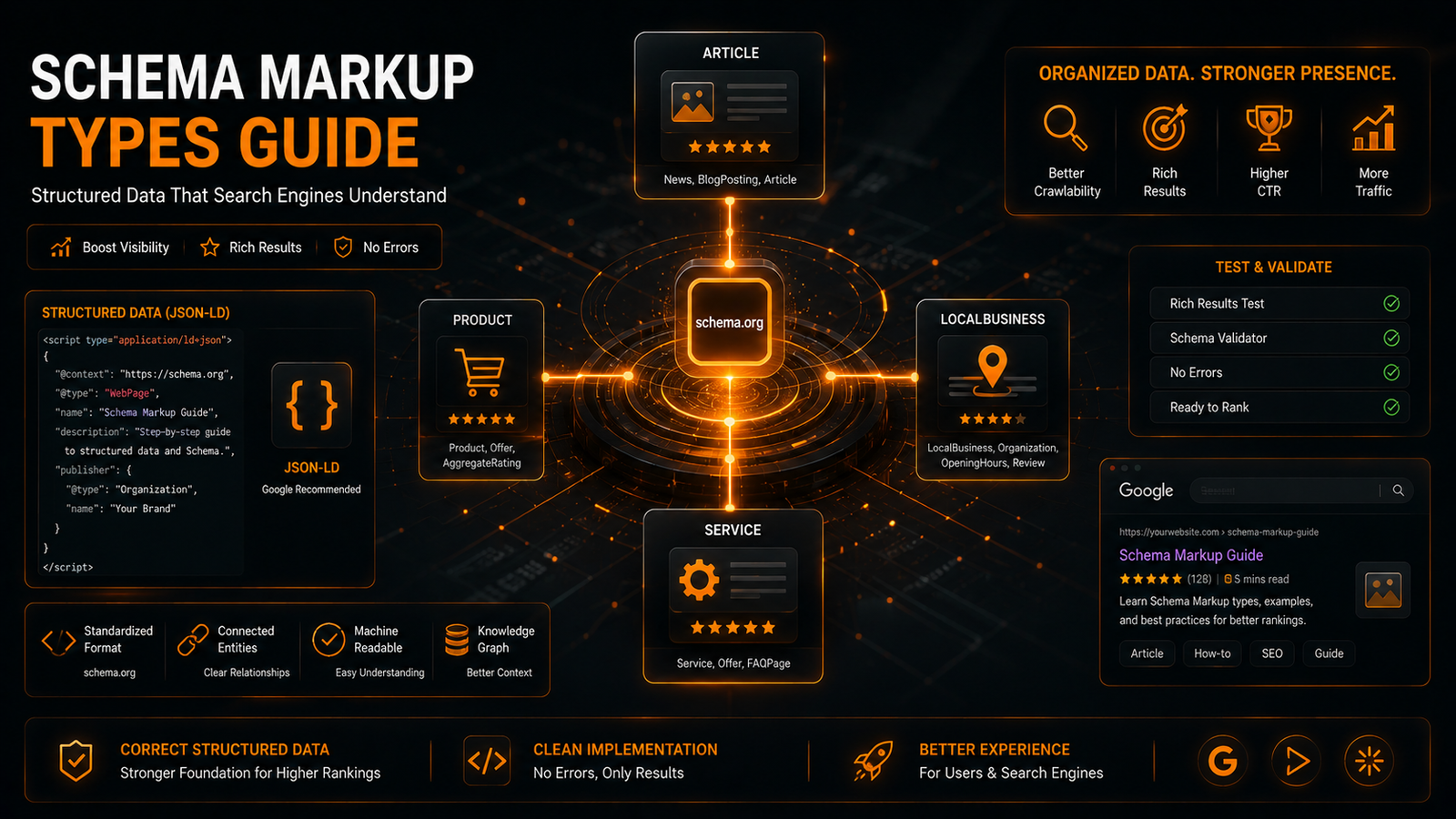
Article and BlogPosting
Article pages may describe the headline, author, publication date, update date and image. Keep every value aligned with visible content. Never invent an author or date simply to improve appearance.
Action to take: match data to the visible page, validate a sample and monitor reports. Contact us at +20 112 326 9452.
Product and Offer
Product pages can describe name, image, description, price, availability, brand and other real attributes. Values must remain accurate as inventory and price change. Do not use product entities on a generic category page.
Action to take: match data to the visible page, validate a sample and monitor reports. Contact us at +20 112 326 9452.
LocalBusiness
A local business page should show a genuine name, address, phone and hours when available. Do not create fake branches for every city. Consistency with the contact page and local profiles matters more than adding fields.
Action to take: match data to the visible page, validate a sample and monitor reports. Contact us at +20 112 326 9452.
Service
A service page should clearly explain scope and provider. Structured data cannot turn an article into a service. Keep the name, description, language, links and CTA consistent with the visible page.
Action to take: match data to the visible page, validate a sample and monitor reports. Contact us at +20 112 326 9452.
BreadcrumbList
Breadcrumbs explain where a URL sits in the site hierarchy. Items should be real links in a logical order and should match the Arabic or English structure rather than being copied blindly.
Action to take: match data to the visible page, validate a sample and monitor reports. Contact us at +20 112 326 9452.
FAQ as visible content
Questions and answers should help users and remain visible. Avoid repeating the same block everywhere or hiding answers. Use FAQ content to reduce objections and clarify scope, not to create invisible text.
Action to take: match data to the visible page, validate a sample and monitor reports. Contact us at +20 112 326 9452.
Organization and Person
Organization or Person entities can clarify identity when claims are real and supported. Link the name to official pages and keep the role, biography and profile information consistent with what visitors see.
Action to take: match data to the visible page, validate a sample and monitor reports. Contact us at +20 112 326 9452.
WebSite and internal search
A website search description requires a functioning internal search. Do not declare a search action that produces empty or broken results. Test it after platform or template changes.
Action to take: match data to the visible page, validate a sample and monitor reports. Contact us at +20 112 326 9452.
Types and properties
A type identifies an entity; properties describe it. A wrong type or unsupported property can create warnings and misleading interpretation. Start with the smallest accurate set and expand only when evidence exists.
Action to take: match data to the visible page, validate a sample and monitor reports. Contact us at +20 112 326 9452.
Match visible content
The core rule is consistency. If a page shows a product price or availability, the machine-readable value must agree. A mismatch can cause search engines to ignore the signal and reduces trust.
Action to take: match data to the visible page, validate a sample and monitor reports. Contact us at +20 112 326 9452.
Common mistakes
Frequent errors include duplicated entities, product data on categories, invented reviews, hidden questions and stale prices. Regular audits catch these issues before a template spreads them across the site.
Action to take: match data to the visible page, validate a sample and monitor reports. Contact us at +20 112 326 9452.
Arabic and English versions
Each language needs appropriate names, descriptions, entities and links. Keep language equivalents real and verify canonicals and alternate URLs. Structured data cannot repair weak translation or incorrect language architecture.
Action to take: match data to the visible page, validate a sample and monitor reports. Contact us at +20 112 326 9452.
Large catalogs
Generate entities from reliable templates with clear exceptions. Review variable products, discontinued items and filtered URLs so the system does not create duplicate entities or low-value pages.
Action to take: match data to the visible page, validate a sample and monitor reports. Contact us at +20 112 326 9452.
Validation and monitoring
Validate after release, review Search Console reports and monitor affected URL groups. A valid test does not guarantee a rich result, but it can expose syntax and consistency problems.
Action to take: match data to the visible page, validate a sample and monitor reports. Contact us at +20 112 326 9452.
Structured data and SEO
It is one Technical SEO component, not a substitute for keyword research, content, links or performance. Connect it to page architecture, intent and visibility goals instead of adding markup to every URL.
Action to take: match data to the visible page, validate a sample and monitor reports. Contact us at +20 112 326 9452.
When not to use it
If the information is not on the page, the page is weak or the type does not apply, do not add it. Improving content, architecture and performance may create more value.
Action to take: match data to the visible page, validate a sample and monitor reports. Contact us at +20 112 326 9452.
A practical audit plan
Inventory templates, map each to an appropriate type, sample URLs, repair shared errors and monitor changes. Document owner, release and rollback so development can manage the system safely.
Action to take: match data to the visible page, validate a sample and monitor reports. Contact us at +20 112 326 9452.
Request a review
For recurring warnings, multilingual stores or many service templates, share the domain and report screenshot. A Technical SEO Specialist can prioritize the work after understanding the site, without fixed pricing before diagnosis.
Action to take: match data to the visible page, validate a sample and monitor reports. Contact us at +20 112 326 9452.
Entity mapping
List core entities before selecting a type: organization, person, service, product, article and location. Define their relationships and the page that proves each fact. This prevents duplicate entities and gives developers a clear site model.
Implementation step: record the source, owner and review date, then validate a sample before approval. Contact us at +20 112 326 9452.
Template rules
A reliable template reads values from a trusted source and does not repeat static values across every URL. Define required fields and exceptions. When an image or price is missing, handle it intentionally instead of emitting a misleading entity.
Implementation step: record the source, owner and review date, then validate a sample before approval. Contact us at +20 112 326 9452.
Variable products
When a product has sizes, colors or prices, decide whether the URL represents one item or a group. Availability and price must match what the customer sees. Recheck output after inventory changes because stale data can be worse than no data.
Implementation step: record the source, owner and review date, then validate a sample before approval. Contact us at +20 112 326 9452.
Merged pages
When merging articles or services, update entity, title, URL and internal links together. Old data left behind creates conflicting signals. Record the redirect and final URL, then validate a sample after the migration.
Implementation step: record the source, owner and review date, then validate a sample before approval. Contact us at +20 112 326 9452.
Reviews and ratings
Use reviews only when they are genuine and connected to the item described. Do not copy a business rating onto every service without a basis. Source, count and context matter more than chasing stars.
Implementation step: record the source, owner and review date, then validate a sample before approval. Contact us at +20 112 326 9452.
Author identity
For expert content, show a real author name, role and profile when appropriate. Avoid invented or generic authors. Consistent biographies and links help readers, editors and search engines understand expertise.
Implementation step: record the source, owner and review date, then validate a sample before approval. Contact us at +20 112 326 9452.
Arab markets
Service names and descriptions may differ across Saudi Arabia, the UAE and Iraq. Use an entity that matches the actual market and avoid duplicating one page with only a country name changed. Keep language, scope and contact path consistent.
Implementation step: record the source, owner and review date, then validate a sample before approval. Contact us at +20 112 326 9452.
Connect with analytics
Do not judge structured data only by validation reports. Connect changes to impressions, clicks and conversions, and check whether fixed pages create value. More warnings can simply mean templates expanded, not that performance declined.
Implementation step: record the source, owner and review date, then validate a sample before approval. Contact us at +20 112 326 9452.
Pre-launch testing
Create a test URL for every template and review HTML, data, links and images. Test mobile, desktop, Arabic and English. Never release a broad change without a rollback plan and saved version.
Implementation step: record the source, owner and review date, then validate a sample before approval. Contact us at +20 112 326 9452.
Plugin conflicts
Plugins can generate duplicate entities or conflict with template settings. Choose one source of truth, disable irrelevant fields and review output after updates. More tools do not automatically create more accuracy.
Implementation step: record the source, owner and review date, then validate a sample before approval. Contact us at +20 112 326 9452.
Monthly review
Sample article, product and service URLs each month, record new errors and map them to releases. Prioritize pages with visits and leads. This prevents small template issues spreading across hundreds of URLs.
Implementation step: record the source, owner and review date, then validate a sample before approval. Contact us at +20 112 326 9452.
The SEO consultant role
A consultant does more than add fields. They decide whether the data supports architecture and intent, then coordinate with developers and content owners. Ask for rationale, priority and acceptance criteria, not a guaranteed rich result.
Implementation step: record the source, owner and review date, then validate a sample before approval. Contact us at +20 112 326 9452.
When removal is better
If data is inaccurate, cannot be maintained or does not describe the page, remove it until the source is fixed. Weak or contradictory signals may confuse more than they help. Accuracy and continuity come first.
Implementation step: record the source, owner and review date, then validate a sample before approval. Contact us at +20 112 326 9452.
Documentation and handoff
Maintain a table of template, type, fields, source, owner, review date and validation status. Share it with developers and content teams so future edits preserve the agreed system.
Implementation step: record the source, owner and review date, then validate a sample before approval. Contact us at +20 112 326 9452.
Investment decision
A small site may need a focused review, while a large platform needs rules and automated tests. Decide after understanding templates, languages, catalog size and resources. Do not set fixed implementation pricing before the scope is known.
Implementation step: record the source, owner and review date, then validate a sample before approval. Contact us at +20 112 326 9452.
Eligibility versus appearance
A page can be technically eligible without showing an enhanced treatment for every query. The result depends on query, device, country and page type. Do not use stars or questions as the only KPI; monitor visibility, clicks, visit quality and conversion.
Implementation step: connect the change to evidence and a monitoring metric, and contact us at +20 112 326 9452 when needed.
Pages without one answer
A page that groups many products or services should not emit a detailed entity for an item that is not distinct. Describe the category or organization when that is what visitors see. Accurate simplicity is better than unverifiable fields.
Implementation step: connect the change to evidence and a monitoring metric, and contact us at +20 112 326 9452 when needed.
Brand changes
When a name, logo or domain changes, update organization references, links and profile pages together. Preserve redirects and language equivalents, and review old templates. Documentation prevents identity conflicts.
Implementation step: connect the change to evidence and a monitoring metric, and contact us at +20 112 326 9452 when needed.
Price and currency
For multi-market stores, currency, price and availability must match the page and market. Do not publish one generic price when taxes, currency or shipping differ. Audit automated updates so stale values do not persist.
Implementation step: connect the change to evidence and a monitoring metric, and contact us at +20 112 326 9452 when needed.
Images and entities
An image attached to a product or article must be available and genuinely related to that page. Do not use one logo for every product or an asset that is absent from the visible page. Media management affects accuracy.
Implementation step: connect the change to evidence and a monitoring metric, and contact us at +20 112 326 9452 when needed.
CMS changes
A theme upgrade or SEO plugin can alter output silently. Keep a pre-release HTML sample and validate after updates. If fields duplicate or disappear, pause the release until the source is understood.
Implementation step: connect the change to evidence and a monitoring metric, and contact us at +20 112 326 9452 when needed.
Useful information first
Add fields that clarify the page, such as author, price, title or availability. Do not fill every property because a tool exposes it. Each value should be visible or provable.
Implementation step: connect the change to evidence and a monitoring metric, and contact us at +20 112 326 9452 when needed.
Review the decision with the client
Explain what will be implemented, what will not and which metric will be monitored. This prevents the expectation that structured data alone will rank a site and positions the work inside a broader SEO plan.
Implementation step: connect the change to evidence and a monitoring metric, and contact us at +20 112 326 9452 when needed.