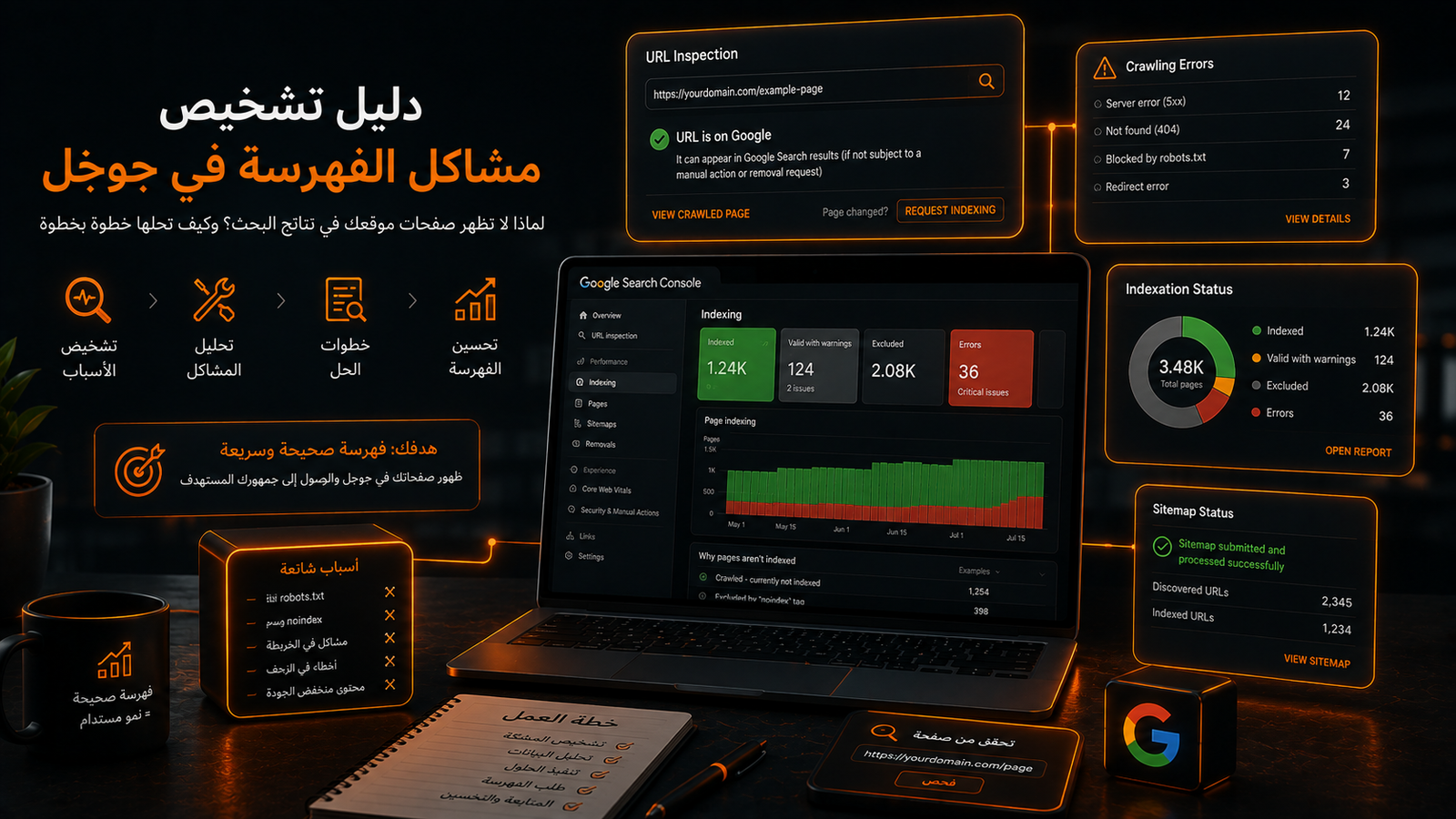
Why aren't your website pages showing up in Google? Crawling and Indexing Guide
You won't be able to utilize half of your website's space thanks to Google because its search engine isn't crawling it or because of technology preventing it from indexing. The main reasons for this blocking on Android devices include issues with the robots.txt file, the use of noindex tags, poor content quality, broken links, and poor structure.
Staging indexation blocks
Review meta robots, X-Robots-Tag and robots.txt after migration. A setting that correctly protects development can remain in production and prevent Google from seeing important pages.
Practical step: document the state before changing it, test across devices and monitor Search Console and business data afterward. If the priority remains unclear, avoid random changes and request a diagnosis that connects the cause to the page, deliverable and review date.
Undiscovered URLs
A browser-accessible URL is not automatically discovered. Review internal links, sitemap coverage and click depth. Add contextual links from trusted pages instead of relying on repeated URL submissions.
Practical step: document the state before changing it, test across devices and monitor Search Console and business data afterward. If the priority remains unclear, avoid random changes and request a diagnosis that connects the cause to the page, deliverable and review date.
Wrong canonical
If a page points to another version or a staging domain, Google may treat the current URL as non-primary. Compare canonical, final URL, language and page purpose before changing signals.
Practical step: document the state before changing it, test across devices and monitor Search Console and business data afterward. If the priority remains unclear, avoid random changes and request a diagnosis that connects the cause to the page, deliverable and review date.
Unclean sitemap
A sitemap full of redirects, 404s and duplicates sends weak signals. Keep only valuable, indexable URLs and monitor Submitted versus Indexed in Search Console.
Practical step: document the state before changing it, test across devices and monitor Search Console and business data afterward. If the priority remains unclear, avoid random changes and request a diagnosis that connects the cause to the page, deliverable and review date.
Server and response failures
5xx errors, timeouts and unstable hosting make crawling unreliable. Review server logs, protection layers and regional tests. Requesting indexing again cannot fix a page that the server fails to deliver.
Practical step: document the state before changing it, test across devices and monitor Search Console and business data afterward. If the priority remains unclear, avoid random changes and request a diagnosis that connects the cause to the page, deliverable and review date.
JavaScript-rendered content
Users may see content after JavaScript runs while crawlers receive incomplete HTML or links. Test the delivered and rendered versions, and keep critical copy and navigation readable without complex interaction.
Practical step: document the state before changing it, test across devices and monitor Search Console and business data afterward. If the priority remains unclear, avoid random changes and request a diagnosis that connects the cause to the page, deliverable and review date.
Thin or duplicate content
Pages can be excluded even when they are not blocked if they add little unique value. Merge overlapping URLs, add useful expertise and examples, or deliberately keep a low-value page out of the index.
Practical step: document the state before changing it, test across devices and monitor Search Console and business data afterward. If the priority remains unclear, avoid random changes and request a diagnosis that connects the cause to the page, deliverable and review date.
Discovered but not indexed
This status needs diagnosis, not repeated submissions. Review quality, duplicates, internal links, intent and external context. Improve, merge or change the role of the page based on evidence.
Practical step: document the state before changing it, test across devices and monitor Search Console and business data afterward. If the priority remains unclear, avoid random changes and request a diagnosis that connects the cause to the page, deliverable and review date.
Keyword cannibalization
When many pages target one intent, Google may hesitate between them. Build a topic map, define one purpose per URL and align titles, links and content to that role.
Practical step: document the state before changing it, test across devices and monitor Search Console and business data afterward. If the priority remains unclear, avoid random changes and request a diagnosis that connects the cause to the page, deliverable and review date.
Broken redirects
After a URL change, redirect chains and 404 destinations can lose signals. Test important old URLs and send each directly to the closest useful destination across devices and languages.
Practical step: document the state before changing it, test across devices and monitor Search Console and business data afterward. If the priority remains unclear, avoid random changes and request a diagnosis that connects the cause to the page, deliverable and review date.
Multilingual versions
Mismatched hreflang, canonical and language URLs can confuse selection. Each version should point to the correct equivalent, contain original useful content and avoid redirect loops.
Practical step: document the state before changing it, test across devices and monitor Search Console and business data afterward. If the priority remains unclear, avoid random changes and request a diagnosis that connects the cause to the page, deliverable and review date.
Programmatic pages and filters
Parameters and faceted navigation can create thousands of weak URLs. Define which combinations deserve indexation, then control internal links, sitemap coverage and technical rules.
Practical step: document the state before changing it, test across devices and monitor Search Console and business data afterward. If the priority remains unclear, avoid random changes and request a diagnosis that connects the cause to the page, deliverable and review date.
Mobile problems
If an important page fails or hides content on mobile, usability and crawling can suffer. Test real devices and confirm that copy, links, images and CTAs remain available.
Practical step: document the state before changing it, test across devices and monitor Search Console and business data afterward. If the priority remains unclear, avoid random changes and request a diagnosis that connects the cause to the page, deliverable and review date.
Slow pages
Speed is not the only indexation cause, but timeouts and poor experience can amplify problems. Review LCP, INP, CLS, image weight and resources on commercial pages.
Practical step: document the state before changing it, test across devices and monitor Search Console and business data afterward. If the priority remains unclear, avoid random changes and request a diagnosis that connects the cause to the page, deliverable and review date.
Weak internal links
An isolated page has little contextual support. Link services to supporting articles and categories to products with useful anchors; do not place every important link only in a footer.
Practical step: document the state before changing it, test across devices and monitor Search Console and business data afterward. If the priority remains unclear, avoid random changes and request a diagnosis that connects the cause to the page, deliverable and review date.
404 and soft 404
An empty page may return 200, while a valuable deleted page may return 404 without a replacement. Review Search Console, improve the 404 experience and redirect only to a genuinely relevant alternative.
Practical step: document the state before changing it, test across devices and monitor Search Console and business data afterward. If the priority remains unclear, avoid random changes and request a diagnosis that connects the cause to the page, deliverable and review date.
Recent site changes
When indexation drops after a release, compare old and new URLs, templates, robots, canonicals and content. Do not make another large change before isolating the trigger.
Practical step: document the state before changing it, test across devices and monitor Search Console and business data afterward. If the priority remains unclear, avoid random changes and request a diagnosis that connects the cause to the page, deliverable and review date.
CMS settings
Platforms may include a global no-index option, duplicate templates or unexpected paths. Review theme, plugin and permission settings before requesting production indexation.
Practical step: document the state before changing it, test across devices and monitor Search Console and business data afterward. If the priority remains unclear, avoid random changes and request a diagnosis that connects the cause to the page, deliverable and review date.
Measure value, not count
Do not use indexed URL count as the only KPI. Monitor important pages, queries, clicks, enquiries and revenue. A large number of indexed pages may have less value than a small set of strong commercial URLs.
Practical step: document the state before changing it, test across devices and monitor Search Console and business data afterward. If the priority remains unclear, avoid random changes and request a diagnosis that connects the cause to the page, deliverable and review date.
When to contact a specialist
If the basics do not explain the problem, send the site URL, a Search Console screenshot and the date of decline. A Technical SEO Specialist can determine whether you need a full indexation audit or a focused review. Contact Mohamed Yahia through the About page or WhatsApp at +20 112 326 9452.
Practical step: document the state before changing it, test across devices and monitor Search Console and business data afterward. If the priority remains unclear, avoid random changes and request a diagnosis that connects the cause to the page, deliverable and review date.
Request an indexation diagnosis
How to read the Indexing report
Group URLs by the reason shown in Search Console instead of reacting to the total count. Sample commercial pages, articles, new URLs and templates. Inspect the title, status code, canonical, robots directives, internal links and rendered content. This turns a broad warning into a short list of repeatable causes.
Action to take: record the change, owner and review date, then compare page-level and group-level data. For a practical review, contact Mohamed Yahia through the About page or WhatsApp at +20 112 326 9452.
Why URL Inspection is only one signal
A single inspected URL can pass while its template blocks hundreds of similar pages. Test several URLs from the same type, compare the live page with the rendered result and review the last crawl date. Repeated submission does not solve a shared CMS or deployment issue.
Action to take: record the change, owner and review date, then compare page-level and group-level data. For a practical review, contact Mohamed Yahia through the About page or WhatsApp at +20 112 326 9452.
Using server logs for crawl decisions
Server logs reveal whether Googlebot reaches priority pages and what response it receives. Look for excessive crawling of filters, parameters and obsolete paths, then compare it with visits to valuable pages. On large ecommerce sites, this evidence helps an Ecommerce SEO Specialist protect crawl resources for revenue-driving URLs.
Action to take: record the change, owner and review date, then compare page-level and group-level data. For a practical review, contact Mohamed Yahia through the About page or WhatsApp at +20 112 326 9452.
Match indexation to search intent
Indexation supports a business goal. An informational page needs a complete answer, evidence and helpful links; a service page needs scope, proof, next steps and a clear CTA. Reviewing intent tells you whether to expand, merge, redirect or reposition a page instead of treating every URL the same.
Action to take: record the change, owner and review date, then compare page-level and group-level data. For a practical review, contact Mohamed Yahia through the About page or WhatsApp at +20 112 326 9452.
A three-stage recovery plan
First remove direct blockers such as noindex, 404 responses and server failures. Next repair architecture: sitemap quality, internal links, canonicals, language paths and templates. Finally improve uniqueness, expertise and commercial relevance. Record every release and monitor the same sample after each stage.
Action to take: record the change, owner and review date, then compare page-level and group-level data. For a practical review, contact Mohamed Yahia through the About page or WhatsApp at +20 112 326 9452.
What to prepare for an SEO review
Share the domain, priority commercial URLs, indexing screenshots, the date the problem began and changes released before the decline. Include platform, countries, languages and conversion goals. This gives a Technical SEO Specialist or Organic Growth Consultant the context needed to scope a useful review.
Action to take: record the change, owner and review date, then compare page-level and group-level data. For a practical review, contact Mohamed Yahia through the About page or WhatsApp at +20 112 326 9452.
Measure business outcomes
Indexed URL count is not a complete KPI. Track impressions and clicks for priority pages, qualified enquiries, revenue, discovery time for new content and crawl errors. Removing low-value URLs can be a positive result when it concentrates signals and improves the quality of organic traffic.
Action to take: record the change, owner and review date, then compare page-level and group-level data. For a practical review, contact Mohamed Yahia through the About page or WhatsApp at +20 112 326 9452.
When a full audit is justified
If important pages are accessible and technically clean but remain absent after a reasonable period, combine technical, content, internal-link and analytics reviews. An SEO Lead can define the scope after understanding the site and competition, then recommend follow-up work without promising a fixed price before the facts are clear.
Action to take: record the change, owner and review date, then compare page-level and group-level data. For a practical review, contact Mohamed Yahia through the About page or WhatsApp at +20 112 326 9452.
Final indexation checklist
Before requesting indexing again, confirm a 200 response, no noindex directive, a relevant canonical, readable HTML, contextual internal links and clean sitemap coverage. Check Arabic and English equivalents, analytics tracking and mobile rendering. Submit only after the underlying issue is fixed.
Ecommerce example
Product URLs may be excluded because of filters, discontinued inventory or copied descriptions. Keep products with demand, connect them to categories and guides, and provide useful alternatives for unavailable items. An Ecommerce SEO Specialist balances crawlability, buying intent, stock and mobile experience.
Local services example
For Saudi Arabia, the UAE, Iraq or wider Arab markets, repeating a city name is not enough. Give each service page a distinct purpose, clear scope, evidence and contact path, then link it to relevant location content without generating near-duplicates. The result is indexation that can produce qualified leads.