Improving Core Web Vitals: Practical Treatment of LCP, INP, and CLS
Is your website still slow despite trying every speed optimization trick? The problem may be more than just loading time. Discover what really affects LCP, INP, and CLS, how to find the root cause, and improve performance without sacrificing user experience or conversions.
What are Core Web Vitals?
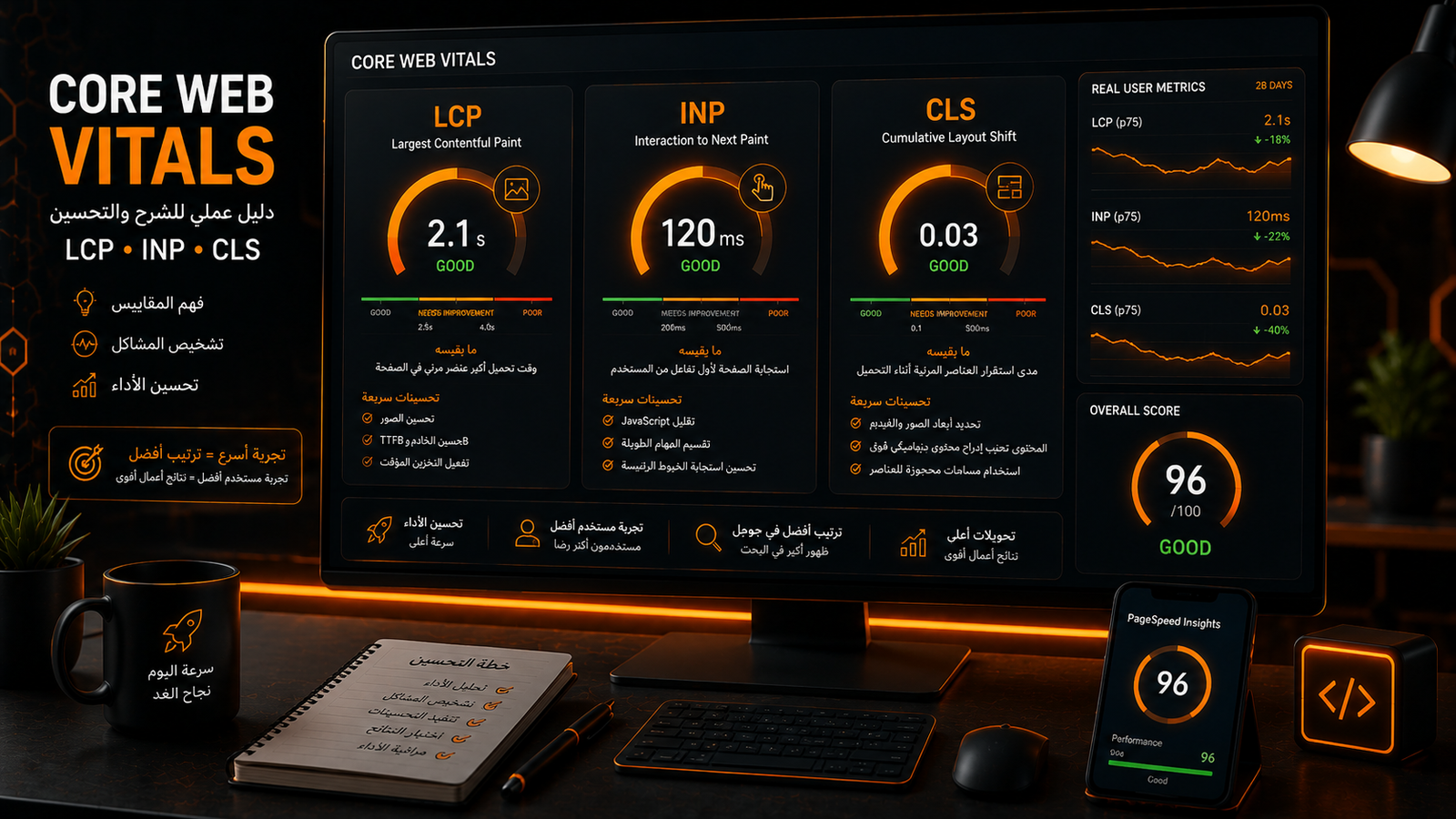
Core Web Vitals describe real user experience through loading, responsiveness and layout stability. Treat them as business signals, not isolated scores. A fast page that hides the service, product or next action will not create demand. The practical goal is to connect performance work with intent, conversion paths, devices and network conditions.
Action to take: document measurements before and after each release, then review devices, languages and conversions. For a performance audit, contact Mohamed Yahia at +20 112 326 9452.
LCP: loading the main content
LCP measures how long the largest visible element takes to appear. It may be a hero image, a headline or a text block. When it is late, the page feels unavailable. Identify the element in PageSpeed Insights and determine whether the delay comes from the image, font, CSS, server response or JavaScript.
Action to take: document measurements before and after each release, then review devices, languages and conversions. For a performance audit, contact Mohamed Yahia at +20 112 326 9452.
INP: interaction responsiveness
INP measures the delay between user interaction and page response across the visit. Search, menus, filters, modals and add-to-cart controls can suffer when JavaScript blocks the main thread or rerenders everything. Reduce work, split long tasks and defer non-critical code while preserving the interaction the customer needs.
Action to take: document measurements before and after each release, then review devices, languages and conversions. For a performance audit, contact Mohamed Yahia at +20 112 326 9452.
CLS: layout stability
CLS rises when elements move after the page starts rendering, such as images without dimensions, late ads or fonts that change text geometry. Sudden movement causes wrong clicks and lowers trust. Reserve space for media and components, and control fonts and banners before content becomes usable.
Action to take: document measurements before and after each release, then review devices, languages and conversions. For a performance audit, contact Mohamed Yahia at +20 112 326 9452.
Field data versus lab data
CrUX and Search Console represent real devices and networks, while Lighthouse and PageSpeed lab runs help isolate causes in a controlled session. Use field data to set priorities and lab data to test solutions. Neither source replaces the other, especially for sites serving several countries.
Action to take: document measurements before and after each release, then review devices, languages and conversions. For a performance audit, contact Mohamed Yahia at +20 112 326 9452.
Why devices produce different results
A page that is excellent on a developer laptop may be slow on a mid-range phone or weak connection. Images, fonts, ads, analytics and server location all matter. Segment reports by mobile, desktop and country instead of trusting a single fast-network test.
Action to take: document measurements before and after each release, then review devices, languages and conversions. For a performance audit, contact Mohamed Yahia at +20 112 326 9452.
Improve server response
High TTFB delays every later step. Review hosting, caching, database queries, middleware, compression, external requests and CDN placement. In Laravel or another dynamic stack, inspect queries and templates before the response leaves the server. Faster HTML often improves both LCP and interaction readiness.
Action to take: document measurements before and after each release, then review devices, languages and conversions. For a performance audit, contact Mohamed Yahia at +20 112 326 9452.
Images and the largest element
Use WebP or AVIF when appropriate, serve responsive dimensions and avoid oversized assets. Do not lazy-load the real LCP image, but do not preload every image either. Preload only the asset that truly appears first and defer media below the fold.
Action to take: document measurements before and after each release, then review devices, languages and conversions. For a performance audit, contact Mohamed Yahia at +20 112 326 9452.
Fonts and CSS delivery
Many font weights and unused CSS delay painting and can shift text. Reduce weights, select a suitable font-display strategy and remove unused rules. Make critical styles available early and defer styles for content that is not initially visible. Test Arabic and English because font geometry differs.
Action to take: document measurements before and after each release, then review devices, languages and conversions. For a performance audit, contact Mohamed Yahia at +20 112 326 9452.
JavaScript and the main thread
Split large bundles, remove unused libraries and load interaction code when it is needed. Reduce recalculation and repaint, use efficient event handling and avoid long click handlers. Chrome DevTools Long Tasks can reveal which work should be fixed first.
Action to take: document measurements before and after each release, then review devices, languages and conversions. For a performance audit, contact Mohamed Yahia at +20 112 326 9452.
Ecommerce performance
Filters, product search, recommendations, reviews and chat widgets can increase INP and page weight. Load them progressively and avoid duplicate requests. Keep product media, price, availability, buy action and essential information accessible in clear HTML.
Action to take: document measurements before and after each release, then review devices, languages and conversions. For a performance audit, contact Mohamed Yahia at +20 112 326 9452.
Arabic and English performance
Translation is not enough. Test RTL direction, headline length, fonts, menus, images and conversion elements in each language. An Arabic version may be slower because of a different font or plugin. Track each language independently while keeping alternate URLs consistent.
Action to take: document measurements before and after each release, then review devices, languages and conversions. For a performance audit, contact Mohamed Yahia at +20 112 326 9452.
Performance and conversion
Performance improvements must protect the CTA. Test contact forms, phone and WhatsApp, and make sure deferring scripts does not delay the action. Compare conversion rate and qualified enquiries before and after; the objective is an easier session and more business, not a score alone.
Action to take: document measurements before and after each release, then review devices, languages and conversions. For a performance audit, contact Mohamed Yahia at +20 112 326 9452.
Common optimization mistakes
Do not preload every image, lazy-load the LCP asset or trust one test. Do not shrink media without measuring quality, and do not remove essential tools without a replacement. Tie every change to a metric, release and date so optimization remains evidence-based.
Action to take: document measurements before and after each release, then review devices, languages and conversions. For a performance audit, contact Mohamed Yahia at +20 112 326 9452.
A 30-day implementation plan
Use week one for measurement and template grouping, week two for server, image and font fixes, week three for JavaScript and interaction work, and week four for device tests, field data and conversion review. Prioritize by affected URLs and commercial value, not by the easiest edit.
Action to take: document measurements before and after each release, then review devices, languages and conversions. For a performance audit, contact Mohamed Yahia at +20 112 326 9452.
How to prioritize fixes
Combine severity, affected page count, page value, implementation effort and expected impact. A shared service template may improve dozens of URLs, while a rare page may not deserve first priority. Document the rationale so developers and marketers share the same order.
Action to take: document measurements before and after each release, then review devices, languages and conversions. For a performance audit, contact Mohamed Yahia at +20 112 326 9452.
Measure after release
Clear caches, test mobile and monitor JavaScript and server errors after deployment. Field data needs time to accumulate, so compare a stable sample rather than expecting instant movement. Expand the fix when experience improves without harming conversion.
Action to take: document measurements before and after each release, then review devices, languages and conversions. For a performance audit, contact Mohamed Yahia at +20 112 326 9452.
When to involve a specialist
Persistent problems across a template require development, analytics and SEO review together. A Technical SEO Specialist or performance consultant can scope the bottleneck after understanding the platform, hosting, countries, languages and goals, without promising a fixed price before diagnosis.
Action to take: document measurements before and after each release, then review devices, languages and conversions. For a performance audit, contact Mohamed Yahia at +20 112 326 9452.
Frequently asked questions
Are Core Web Vitals the only ranking factor? No, they are one part of page experience. Is a score of 100 required? No, a good stable experience is the goal. Does a CDN solve everything? No, HTML, JavaScript and media still matter. Does deleting content help? Only when it is unnecessary and the effect on intent and conversion is understood.
Action to take: document measurements before and after each release, then review devices, languages and conversions. For a performance audit, contact Mohamed Yahia at +20 112 326 9452.
Read the waterfall before choosing a fix
Open the request waterfall before installing another optimization plugin. Find the first slow request, render-blocking chain and resources loaded before they are visible. Separate server time, transfer time and execution time. This prevents an LCP fix when the real cause is TTFB or blocking CSS.
Implementation step: attach the measurement, evidence and acceptance threshold to the task, then monitor a stable sample after release.
Laravel performance testing
Review middleware, queries, templates and external requests. Cache suitable data, avoid repeated queries inside loops and compress HTML and assets. For dynamic pages, measure from the customer region because a fast server response alone does not guarantee timely rendering of the largest element.
Implementation step: attach the measurement, evidence and acceptance threshold to the task, then monitor a stable sample after release.
WordPress performance testing
Inspect the theme, plugins, analytics and fonts before adding another cache layer. Remove assets unused by each template, serve correct image sizes and stop plugins from adding JavaScript to pages that do not need it. Test product, service and article templates separately.
Implementation step: attach the measurement, evidence and acceptance threshold to the task, then monitor a stable sample after release.
CDN and caching choices
A CDN can reduce asset distance and improve TTFB, but it cannot repair a slow database or oversized JavaScript bundle. Set cache headers carefully, exclude personalized or cart pages and test cache invalidation after a release so visitors do not receive stale content.
Implementation step: attach the measurement, evidence and acceptance threshold to the task, then monitor a stable sample after release.
Third-party scripts
Chat, ads and session recording tools each add connections and execution. Keep tools tied to a clear marketing decision and load non-critical scripts after content and first interaction. Measure their impact; a small script can still delay the page through a long connection chain.
Implementation step: attach the measurement, evidence and acceptance threshold to the task, then monitor a stable sample after release.
Images on service pages
Choose an image that supports the message rather than a huge decorative asset. Define dimensions, serve a mobile version and prioritize by position. Do not let a promotional image delay the headline and value proposition. If the image is LCP, test priority and preload with evidence.
Implementation step: attach the measurement, evidence and acceptance threshold to the task, then monitor a stable sample after release.
Real-user testing
Ask people on mid-range phones to search, open menus, submit a form and add a product to cart. Note where they wait or tap twice. Metrics show where friction exists; observation explains why that friction affects trust and buying behavior.
Implementation step: attach the measurement, evidence and acceptance threshold to the task, then monitor a stable sample after release.
Connect performance to revenue
Segment conversions by device, landing template and speed band. Track exits, form submissions, calls and WhatsApp clicks. Improving INP on a contact form can matter more commercially than shaving milliseconds from a page that never generates enquiries.
Implementation step: attach the measurement, evidence and acceptance threshold to the task, then monitor a stable sample after release.
Developer handoff checklist
Give the developer the URL, template, affected metric, evidence, proposed fix, acceptance threshold and rollback method. Agree on mobile, desktop, Arabic and English testing. This turns a consultant recommendation into a measurable development task.
Implementation step: attach the measurement, evidence and acceptance threshold to the task, then monitor a stable sample after release.
Monthly performance maintenance
Review new templates, media, plugins, campaigns and code monthly. Performance changes with content and inventory, so it is not a one-time task. Alert on rising LCP, INP or CLS, and prioritize pages with the most visits and conversions.
Implementation step: attach the measurement, evidence and acceptance threshold to the task, then monitor a stable sample after release.
The right measurement cycle
Measure at three points: before the fix, immediately after release and after enough real-user data accumulates. Keep lab tests consistent, then compare field reports over a meaningful period. Do not confuse a temporary cache improvement with a stable experience for visitors.
Implementation step: record the decision, owner and review date, and connect the result to a performance, experience and conversion metric.
Performance during campaigns
A campaign or new tracking code can change the page. Test before, during and after the campaign, and watch ads, media and landing-page scripts. Marketing and development teams should treat every new tool as a release that requires a performance check.
Implementation step: record the decision, owner and review date, and connect the result to a performance, experience and conversion metric.
Release mistakes that bring problems back
A deployment can restore an old template, remove cache headers or ship a larger bundle. Add checks to CI/CD for final HTML, asset weight, JavaScript errors and image dimensions. If performance falls, return to the last healthy release before experimenting in production.
Implementation step: record the decision, owner and review date, and connect the result to a performance, experience and conversion metric.
Assign ownership
Developers own code and hosting, designers own media and layout, content owners protect the message, and SEO connects performance to crawling, intent and conversion. Give every fix an owner, acceptance threshold and review date so the audit becomes action.
Implementation step: record the decision, owner and review date, and connect the result to a performance, experience and conversion metric.
The commercial decision
Not every technical point deserves unlimited time. If a small score gain needs a full template rebuild, compare effort with affected URLs and customer value. Start with shared high-impact changes, then expand after measurable evidence appears.
Implementation step: record the decision, owner and review date, and connect the result to a performance, experience and conversion metric.