SEO: A Complete Search Engine Optimization Strategy for Visibility, Leads & Sustainable Growth .
Search Engine Optimization (SEO) is not about adding keywords to a page and waiting for Google to rank it. Modern SEO is a complete growth system that connects technical performance, search intent, content quality, authority, user experience, artificial intelligence search, and conversion optimization. When these elements work together, your website becomes more than a collection of optimized pages. It becomes a long-term digital asset capable of attracting qualified users, building trust, generating leads, and supporting sustainable business growth. The real goal of SEO is not simply to rank higher. It is to make your business visible to the right audience, at the right stage of their search journey, with the right page and the right message.
Search Engine Optimization (SEO) is not about adding keywords to a page and waiting for Google to rank it.
Modern SEO is a complete growth system that connects technical performance, search intent, content quality, authority, user experience, artificial intelligence search, and conversion optimization.
When these elements work together, your website becomes more than a collection of optimized pages. It becomes a long-term digital asset capable of attracting qualified users, building trust, generating leads, and supporting sustainable business growth.
The real goal of SEO is not simply to rank higher.
It is to make your business visible to the right audience, at the right stage of their search journey, with the right page and the right message.
What Is Search Engine Optimization (SEO)?
Search Engine Optimization is the process of improving a website so that search engines can better discover, understand, evaluate, and present its pages to users searching for relevant information, products, or services.
However, modern SEO goes far beyond ranking for individual keywords.
Search engines are increasingly focused on understanding:
What the user is actually looking for.
Which result best satisfies the search intent.
Whether the content is useful and trustworthy.
Whether the website demonstrates genuine expertise.
Whether the page provides a good user experience.
Whether the information is clear and relevant.
Whether the website is a credible source within its subject area.
That is why a strong SEO strategy does not start with:
"Which keyword should we rank for?"
It starts with:
"What does our customer need, why are they searching for it, and what is the best answer or solution we can provide?"
How Do Search Engines Work?
For a page to appear in organic search results, search engines need to discover it, understand it, store it in their index, and evaluate whether it is relevant enough to appear for a particular search.
Three fundamental stages are particularly important.
1. Crawling
Search engines discover pages through internal links, external links, XML sitemaps, and other signals.
If an important page cannot be reached or is incorrectly blocked, search engines may struggle to discover or crawl it.
Technical SEO therefore examines:
Internal linking.
XML sitemaps.
Robots.txt.
Broken links.
Redirect chains.
Redirect loops.
Orphan pages.
Crawl accessibility.
Important pages with weak internal signals.
2. Indexing
After discovering a page, search engines need to understand its content and determine whether it should be stored in the search index.
This makes technical SEO and content quality closely connected.
We analyze elements such as:
Canonical URLs.
Meta robots directives.
Duplicate and near-duplicate pages.
Content quality.
Page structure.
Heading hierarchy.
Structured data.
Relationships between pages.
Overall usefulness of the content.
A page existing on your website does not automatically mean it will appear in search results.
3. Ranking
When someone performs a search, search engines evaluate many signals to determine which results are most relevant and useful.
Simply including the keyword is not enough.
A competitive page needs to align with:
Search intent + relevance + usefulness + trust + expertise + accessibility + user experience.
This is the difference between trying to "rank a page" and building a website that deserves to become one of the best answers in its market.
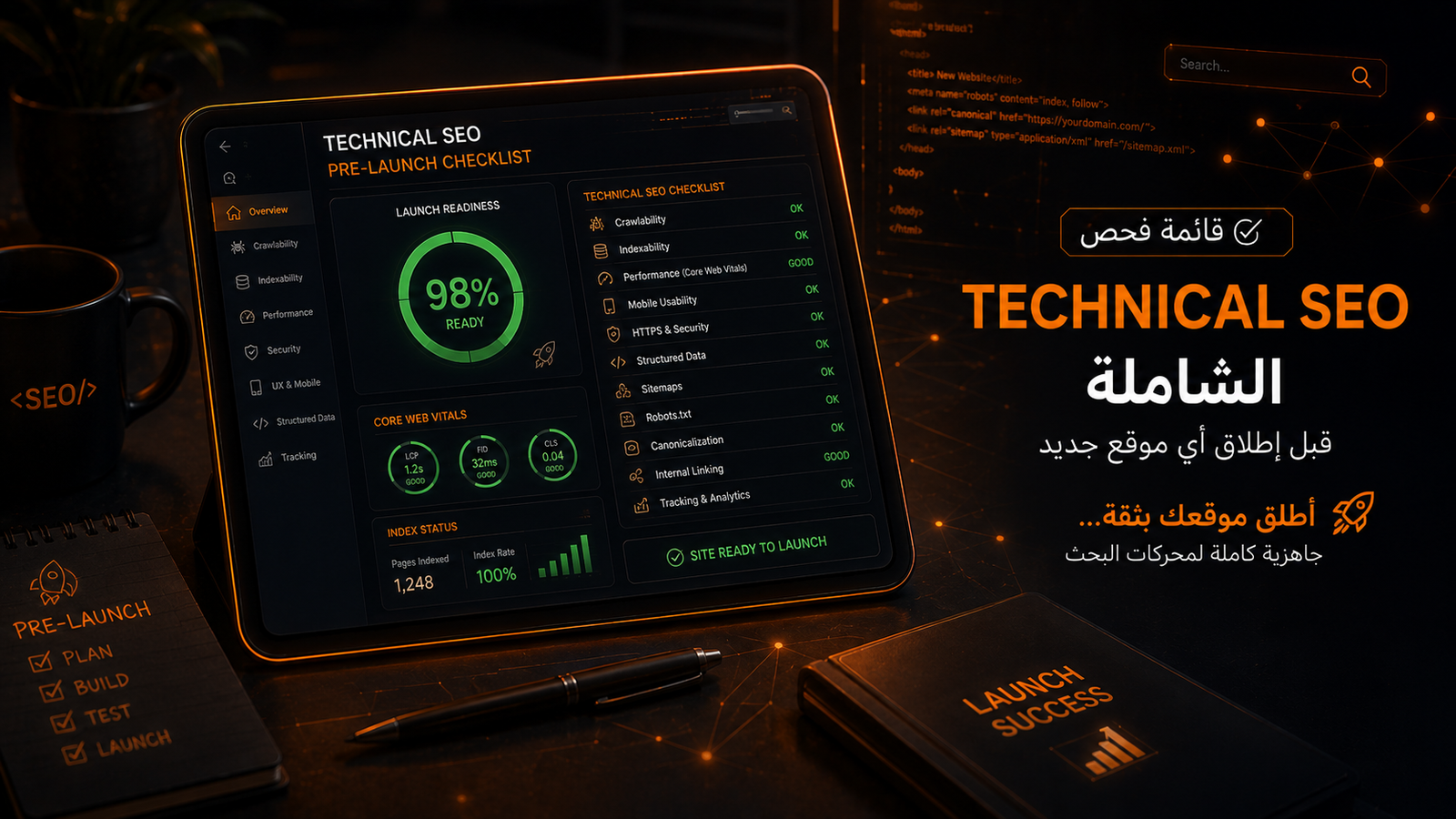
Technical SEO: The Foundation of Organic Growth
You can have excellent content, but technical problems involving crawling, indexing, performance, or site architecture can prevent that content from reaching its full potential.
That is why technical SEO is the foundation of a successful search strategy.
What Does Technical SEO Include?
Crawling & Indexing
We analyze:
Indexed and non-indexed pages.
Indexing exclusions.
Crawl errors.
Robots.txt.
XML Sitemap.
Noindex directives.
Canonical implementation.
Redirects.
404 errors.
Soft 404 pages.
Duplicate content.
Crawl accessibility.
Website Architecture
Your website structure should make sense to both users and search engines.
We evaluate:
Site architecture.
Categories.
Navigation.
Internal linking.
Orphan pages.
URL structure.
Internal authority distribution.
Relationships between important pages.
A well-structured website makes it easier for search engines to understand which pages matter most.
Page Speed & User Experience
SEO is not only about search engines.
The experience users have after clicking your result matters.
We analyze:
Content loading performance.
Page responsiveness.
Visual stability.
Images.
JavaScript.
CSS.
Fonts.
Caching.
Render-blocking resources.
Mobile performance.
The goal is to create pages that are both search-friendly and user-friendly.
Mobile SEO: Build for the User First
A mobile website should not simply be a smaller version of the desktop website.
It should provide a complete and frictionless experience.
Important considerations include:
Responsive design.
Readable typography.
Easy navigation.
Touch-friendly buttons.
Clear calls to action.
Fast loading.
Accessible content.
Easy product and service discovery.
The essential content available to mobile users should also accurately represent the important information search engines need to understand the page.
Keyword Research Starts With Search Intent
One of the biggest SEO mistakes is choosing keywords based only on search volume.
Search volume does not automatically equal business value.
A keyword with thousands of monthly searches may generate very little revenue if the people searching it have no intention of becoming customers.
A lower-volume keyword may be far more valuable if it comes from someone who is ready to compare providers, request a service, or make a purchase.
That is why keyword research should be built around search intent.
Informational Intent
The user wants to learn.
Examples:
What is SEO?
How does SEO work?
How do search engines rank websites?
Commercial Investigation
The user is evaluating options.
Examples:
Best SEO agency.
SEO consultant comparison.
Best SEO services for ecommerce.
Transactional Intent
The user is close to taking action.
Examples:
SEO consultant.
SEO agency.
SEO audit service.
Book an SEO consultation.
Purchase Intent
The user is actively looking for a product or service and is ready to make a decision.
These searches often represent some of the highest commercial opportunities.
From Keywords to Topic Authority
Modern SEO should not rely on creating dozens of disconnected pages targeting isolated keywords.
A stronger approach is to build topical authority.
For example, an SEO website should not only have a general SEO service page.
It can build a connected content ecosystem around:
Technical SEO.
Ecommerce SEO.
Local SEO.
Keyword Research.
Content SEO.
Internal Linking.
Schema Markup.
SEO Audits.
Google Search Console.
Core Web Vitals.
AEO.
GEO.
SEO Strategy.
SEO Reporting.
These pages and articles can then be connected through a strategic internal linking structure.
The objective is not simply to publish more content.
The objective is to demonstrate depth, relevance, and expertise across an entire subject.
Content That Builds Trust and Supports Decisions
Long content is not automatically good content.
A 5,000-word article can still be weak if it simply repeats information already available everywhere else.
The goal is to give users:
A clear answer + useful context + practical guidance + evidence + examples + a logical next step.
Strong SEO content should include:
Direct answers.
Clear explanations.
Practical examples.
Original insights.
Relevant evidence.
Step-by-step guidance.
Comparisons where useful.
Common mistakes.
Frequently asked questions.
Relevant internal links.
Appropriate calls to action.
The question is not:
"How many words should this article have?"
The better question is:
"How much information does the user need to make a better decision?"
Expertise and Trust Matter
Search visibility is not only about writing well.
In competitive industries, content should demonstrate why the information deserves to be trusted.
This can be supported through:
Real experience.
Practical expertise.
Case studies.
Examples.
Author information.
Professional background.
Reliable sources.
Original insights.
Updated information.
Clear business information.
Users do not need another generic article.
They need an answer they can trust.
On-Page SEO: Make the Page Understandable
On-page SEO is not about repeating a keyword as many times as possible.
It is about making the entire page clear, relevant, useful, and easy to understand.
Important elements include:
SEO Title.
Meta Description.
H1.
H2 and H3 structure.
Descriptive URL.
Strong introduction.
Natural keyword usage.
Related terminology and entities.
Image optimization.
Alt text.
Internal links.
Relevant external references.
Structured data.
Clear CTA.
Readable page layout.
Every SEO element should serve a purpose.
Internal Linking: Build a Logical Website
Internal links are much more than navigation elements.
They can help search engines:
Discover pages.
Understand relationships between topics.
Identify important pages.
Distribute internal signals.
Understand content hierarchy.
Connect informational content with commercial pages.
A strong internal link should make sense within the context.
For example, an article discussing Technical SEO can naturally link to a detailed SEO Audit page or a Core Web Vitals guide.
This creates a connected ecosystem rather than isolated pages.
Structured Data & Schema Markup
Structured data helps search engines understand specific information about a page in a machine-readable format.
Depending on the content and eligibility, websites may use structured data such as:
Organization.
WebSite.
BreadcrumbList.
Article.
Product.
LocalBusiness.
Service.
FAQPage when appropriate and eligible.
Schema markup is not a magic ranking shortcut.
Its value comes from accurately describing the content that actually exists on the page.
Ecommerce SEO
Ecommerce SEO requires a different approach because online stores often contain:
Product pages.
Category pages.
Filters.
Search pages.
Product variants.
Similar products.
Discontinued products.
Duplicate URLs.
Faceted navigation.
Pages with different commercial values.
A strong ecommerce SEO strategy may include:
Product SEO.
Category SEO.
Keyword mapping.
Product title optimization.
Product descriptions.
Structured data.
Canonicalization.
Indexation management.
Image optimization.
Internal linking.
Category optimization.
Out-of-stock product management.
Conversion optimization.
The objective is to move the customer from:
Search → Product/Category Page → Decision → Purchase
Local SEO: Reach Customers in the Right Location
If your business serves a specific city, region, or local market, appearing in front of the right geographic audience can be more valuable than generating large volumes of irrelevant traffic.
Local SEO can include:
Local service pages.
Geographic search intent.
Business profile optimization.
Consistent business information.
Local authority signals.
Location-focused content.
Mobile optimization.
Local relevance.
The objective is not to appear everywhere.
It is to appear in front of the right customer in the right location.
AEO: Answer Engine Optimization
Search is increasingly becoming answer-driven.
Users often want a direct answer instead of opening multiple websites and comparing information themselves.
This is where Answer Engine Optimization (AEO) becomes important.
Content should be structured so that questions can be answered clearly and directly.
Examples include:
What is SEO?
How does SEO work?
What is the difference between SEO and AEO?
How long does SEO take?
Is SEO worth it?
How much does SEO cost?
A strong structure often begins with a concise answer, followed by deeper explanation for users who want more detail.
GEO: Generative Engine Optimization
Generative Engine Optimization (GEO) focuses on improving how clearly your content can be understood, retrieved, summarized, and potentially referenced within AI-powered search and answer experiences.
The question is no longer only:
"Does my website rank?"
It is increasingly:
"Does the system understand what my business does and why my content is relevant?"
This makes several areas increasingly important:
Clear information architecture.
Topical depth.
Demonstrated expertise.
Entity relationships.
Structured information.
Reliable sources.
Digital reputation.
Specialized content.
Consistent brand information.
SEO and AI Search: Visibility Is Becoming More Complex
Search behavior is evolving.
A user may begin with a traditional Google search, interact with an AI-generated answer, compare several providers, visit a specialist website, and then return to search before making a final decision.
This means SEO should not be built around a single ranking position.
The goal is to build a digital presence that is:
Discoverable.
Understandable.
Credible.
Topically relevant.
Useful across different stages of the search journey.
Conversion SEO: Turn Search Traffic Into Business Results
One of the biggest mistakes in SEO is celebrating traffic growth without understanding the quality of that traffic.
1,000 irrelevant visitors can be less valuable than 100 highly qualified visitors.
That is why we analyze:
Which pages attract qualified visitors?
Which keywords generate leads?
Which landing pages convert?
Which services receive commercial searches?
Which products generate revenue?
Which CTAs work?
Where do users abandon the journey?
SEO success should not end with:
"We reached position one."
The more important question is:
"What happened after the user clicked?"
How Should SEO Performance Be Measured?
A strong SEO strategy requires more than a single metric.
Visibility
Is the website appearing for more relevant searches?
Clicks
Are impressions turning into visits?
Rankings
Which keywords and pages are gaining visibility?
Qualified Traffic
Are the visitors relevant to the business?
Conversions
Are users submitting forms, calling, booking, or purchasing?
Revenue
Is organic search contributing to measurable business growth?
The goal is to connect search performance with actual business outcomes.
A 7-Stage SEO Growth Process
Stage 1: SEO Audit
We begin by understanding the current state of the website.
The audit can cover:
Technical SEO.
Indexing.
Content.
Keywords.
Competitors.
Internal linking.
Structured data.
Performance.
User experience.
Growth opportunities.
Stage 2: Competitor Analysis
Competitor analysis is not about copying competitors.
It is about identifying:
What are they doing that we are not doing?
And:
Where are the opportunities they have not fully captured?
We can analyze:
Keyword coverage.
Landing pages.
Content depth.
Site structure.
Internal linking.
Topic coverage.
Commercial pages.
Strengths and weaknesses.
The result is a list of actionable opportunities.
Stage 3: Keyword & Search Intent Mapping
We map keywords and search intents to the pages that should target them.
Instead of having several pages competing for the same search intent, each important topic receives a clear destination.
This improves site structure and reduces unnecessary keyword cannibalization.
Stage 4: Technical Optimization
Technical problems are prioritized based on potential impact.
The goal is to focus resources where they can generate the greatest improvement.
A practical approach is:
Impact × Effort
High-impact, manageable opportunities should usually come first.
Stage 5: Content Strategy
We identify:
Pages that need improvement.
New pages that should be created.
Articles that need updating.
Missing topics.
Unanswered questions.
Commercial opportunities.
Topic clusters.
Internal linking opportunities.
Stage 6: Authority & Trust
We strengthen the website's ability to demonstrate expertise and credibility through appropriate content, relevant external signals, strong information architecture, and trustworthy references.
The exact strategy depends on the industry, market, competition, and business model.
Stage 7: Measure, Learn & Optimize
SEO is not a one-time project.
Search behavior changes.
Competitors change.
Markets change.
Search systems change.
Your own business changes.
That is why SEO requires continuous analysis, testing, updating, and optimization.
What works should be expanded.
What does not work should be analyzed.
What has become outdated should be improved.
What Makes a Strong SEO Strategy?
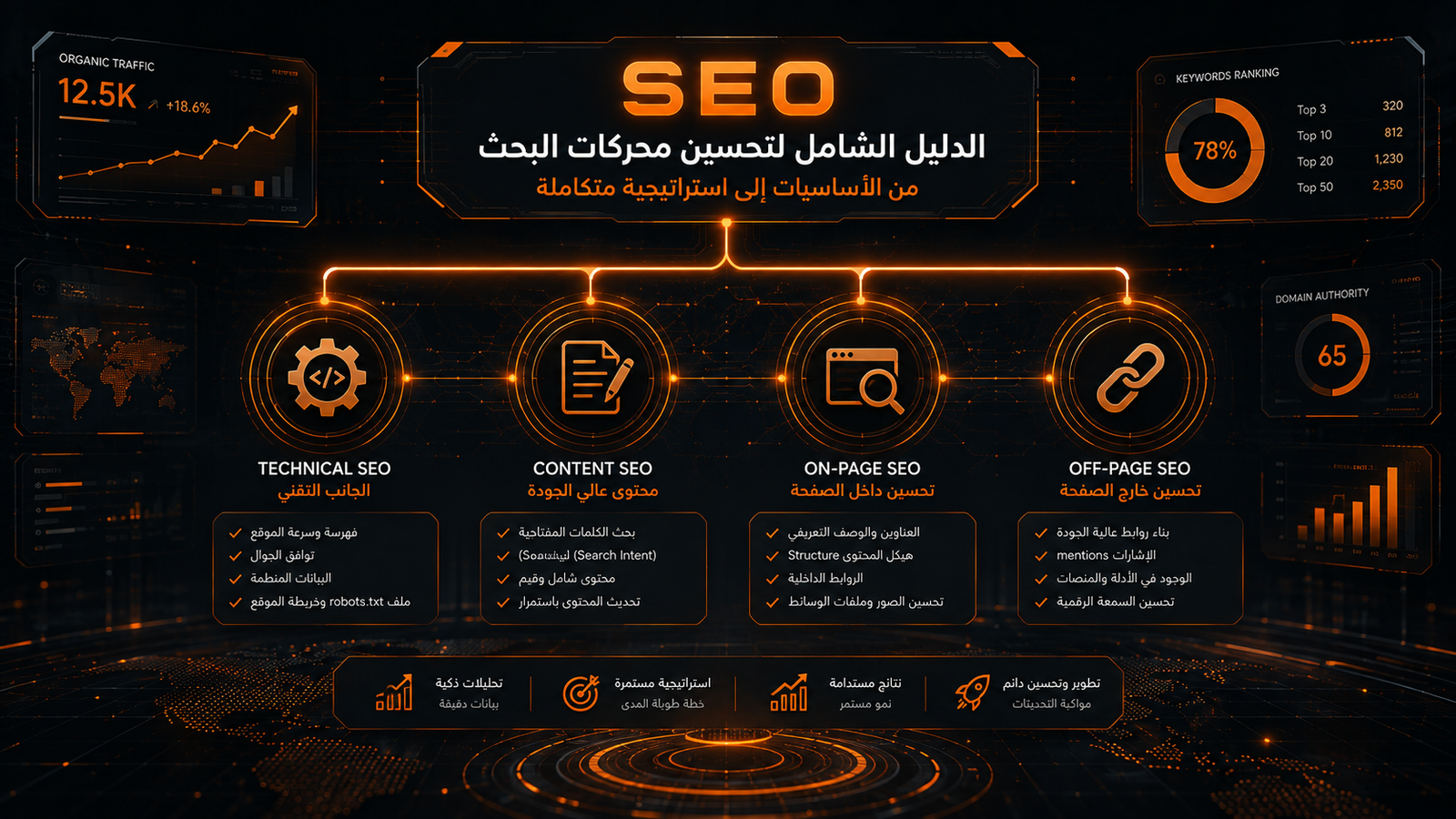
A mature SEO strategy combines several layers:
Layer | Purpose |
|---|---|
Technical SEO | Make the website accessible and understandable |
Content SEO | Satisfy search intent with useful content |
Authority | Build expertise, trust, and topical relevance |
AEO & GEO | Improve visibility across answer-driven and AI-powered search experiences |
Conversion SEO | Turn qualified organic traffic into business results |
Focusing on only one layer leaves significant growth opportunities untouched.
SEO Is Not a Short-Term Campaign
Some SEO improvements can produce relatively fast changes.
However, building a strong organic presence generally requires consistency.
You are not simply building rankings.
You are building:
A stronger website + better content + topical authority + trust + data + user experience + conversion paths.
As these assets compound, organic search can become a sustainable acquisition channel rather than a source of traffic that disappears when advertising stops.
Why Treat SEO as a Growth System?
Because the problem is rarely just one keyword.
You may have:
Excellent pages that are not properly indexed.
Good content targeting the wrong search intent.
Large amounts of traffic with little commercial value.
Strong products that are difficult to discover.
A fast website without a content strategy.
Keywords assigned to the wrong pages.
High rankings that generate little business.
The solution is to understand the entire system.
First identify the problem.
Then prioritize the opportunity.
Then execute.
Then measure.
Then improve.
What Can a Complete SEO Strategy Include?
Comprehensive SEO Audit
A technical and strategic analysis designed to identify problems, opportunities, and priorities.
Keyword Research & Strategy
Keyword selection based on search intent, commercial value, competition, and business objectives.
Content Strategy
A structured content ecosystem designed around customer journeys and topical authority.
Technical SEO
Crawling, indexing, architecture, performance, redirects, canonicalization, and other technical areas.
On-Page SEO
Titles, headings, content structure, internal linking, images, structured data, and conversion elements.
Ecommerce SEO
Product, category, filtering, indexation, internal linking, and commercial search optimization.
Local SEO
Improving visibility for customers searching within targeted locations.
AEO & GEO
Preparing content for answer-driven search and emerging AI-powered search experiences.
SEO Consulting
Strategic guidance for businesses that need clear priorities, technical direction, or an SEO growth roadmap.
Do You Need More Traffic or More Customers?
This is one of the most important questions to answer before building an SEO strategy.
If the objective is simply traffic growth, you can target high-volume informational keywords.
But if the objective is more qualified leads, sales, bookings, or revenue, the strategy must focus on:
Commercial search intent.
High-value services.
High-value products.
Geographic opportunities.
Conversion-focused landing pages.
Buyer journey content.
Competitor gaps.
Revenue-generating keywords.
Because traffic is not the final objective.
The objective is to bring the right customer to the right page at the right moment.
Turn SEO Into a Sustainable Growth Asset
If your website is not receiving the visibility it deserves, or if it receives traffic without generating meaningful business results, the problem may not be a lack of keywords.
The underlying issue could be:
Technical SEO, search intent, content quality, indexing, authority, site architecture, competition, user experience, or conversion.
This is where a professional SEO strategy begins.
The goal is to analyze these layers together and turn the data into a clear, prioritized, measurable growth plan.
SEO Services
SEO Audit
A comprehensive analysis of technical, content, search, and competitive opportunities.
Technical SEO
Improve crawling, indexing, architecture, performance, and technical health.
SEO Content Strategy
Build keyword, topic, and content strategies aligned with business objectives.
Ecommerce SEO
Optimize products, categories, internal linking, indexation, and commercial search visibility.
Local SEO
Increase visibility among customers searching within your target locations.
AEO & GEO
Optimize content for answer-driven search and AI-powered search experiences.
SEO Consulting
Get expert guidance on priorities, strategy, implementation, and long-term growth.
Is Your Website Ready for Better Search Visibility?
Before creating more content, find out what is actually preventing your website from growing.
A professional SEO analysis should answer:
Where are we now?
What is preventing growth?
Which opportunities are being missed?
What should we prioritize first?
How will we measure success?
Book Your SEO Consultation
Get a professional analysis of your website and identify the SEO opportunities that can improve visibility, attract qualified users, and turn organic search into measurable business growth.
Book Your Consultation Now →
Frequently Asked Questions About SEO
What is SEO?
SEO is the process of improving a website's visibility in organic search results by optimizing its technical structure, content, relevance, authority, user experience, and overall search performance.
How long does SEO take to produce results?
There is no universal timeline. Results depend on the website's current authority, technical condition, competition, content quality, industry, implementation speed, and the scope of the strategy.
SEO should therefore be evaluated through performance trends rather than a fixed promise of reaching a particular ranking by a particular date.
Is SEO just about writing blog posts?
No.
Blog content is only one part of SEO.
A complete strategy can include technical SEO, service pages, product and category optimization, internal linking, indexing, structured data, content optimization, authority building, local SEO, and conversion optimization.
Can a website rank without technical SEO?
Some pages can rank despite technical limitations, but serious technical problems can prevent search engines from properly discovering, crawling, understanding, or indexing important pages.
Technical SEO provides the foundation on which content and authority can perform effectively.
Are keywords still important?
Yes.
However, modern SEO is not about repeating the same keyword.
It is about understanding the relationship between search terms, search intent, entities, topics, content depth, and the user's actual needs.
Is SEO useful for ecommerce businesses?
Absolutely.
Ecommerce SEO can help products and categories become discoverable for valuable commercial searches and can support the journey from search visibility to product discovery and purchase.
What is the difference between SEO, AEO, and GEO?
SEO focuses broadly on improving organic search visibility.
AEO focuses on creating clear, structured answers to user questions.
GEO focuses on improving how clearly content can be understood and used within AI-powered search and generative answer experiences.
These approaches can work together as part of a modern search strategy.
Does ranking #1 mean SEO is successful?
Not necessarily.
A top ranking is valuable, but it is not the final business objective.
If a page ranks highly but attracts irrelevant visitors and generates no leads or sales, the strategy still needs improvement.
Successful SEO connects:
Visibility → Clicks → Qualified Traffic → Engagement → Conversions → Business Value
Can anyone guarantee the #1 position on Google?
No responsible SEO strategy can guarantee a permanent #1 ranking.
Search results change because of competition, search behavior, algorithmic systems, content quality, and market conditions.
The better approach is to build a technically strong, useful, authoritative, and adaptable website that can compete consistently.
Final Thoughts
SEO is no longer a simple keyword-ranking exercise.
It is a complete process of understanding:
Users + Search Intent + Competition + Website Technology + Content + Authority + AI Search + Conversion.
When these elements work together, your website becomes better positioned to:
Get discovered by the right audience, earn trust, attract qualified traffic, and turn organic search into sustainable business growth.
Mohamed Yahia — SEO / AEO / GEO
© 2026 Mohamed Yahia