Entity SEO and Knowledge Graph Signals for Stronger Brands
Does Google—and your audience—really understand who your brand is? The problem may not be a lack of keywords, but conflicting signals across your name, services, markets, and online profiles. Discover how to build a clear, connected digital entity and make your website and trusted sources easier to understand, verify, and trust.
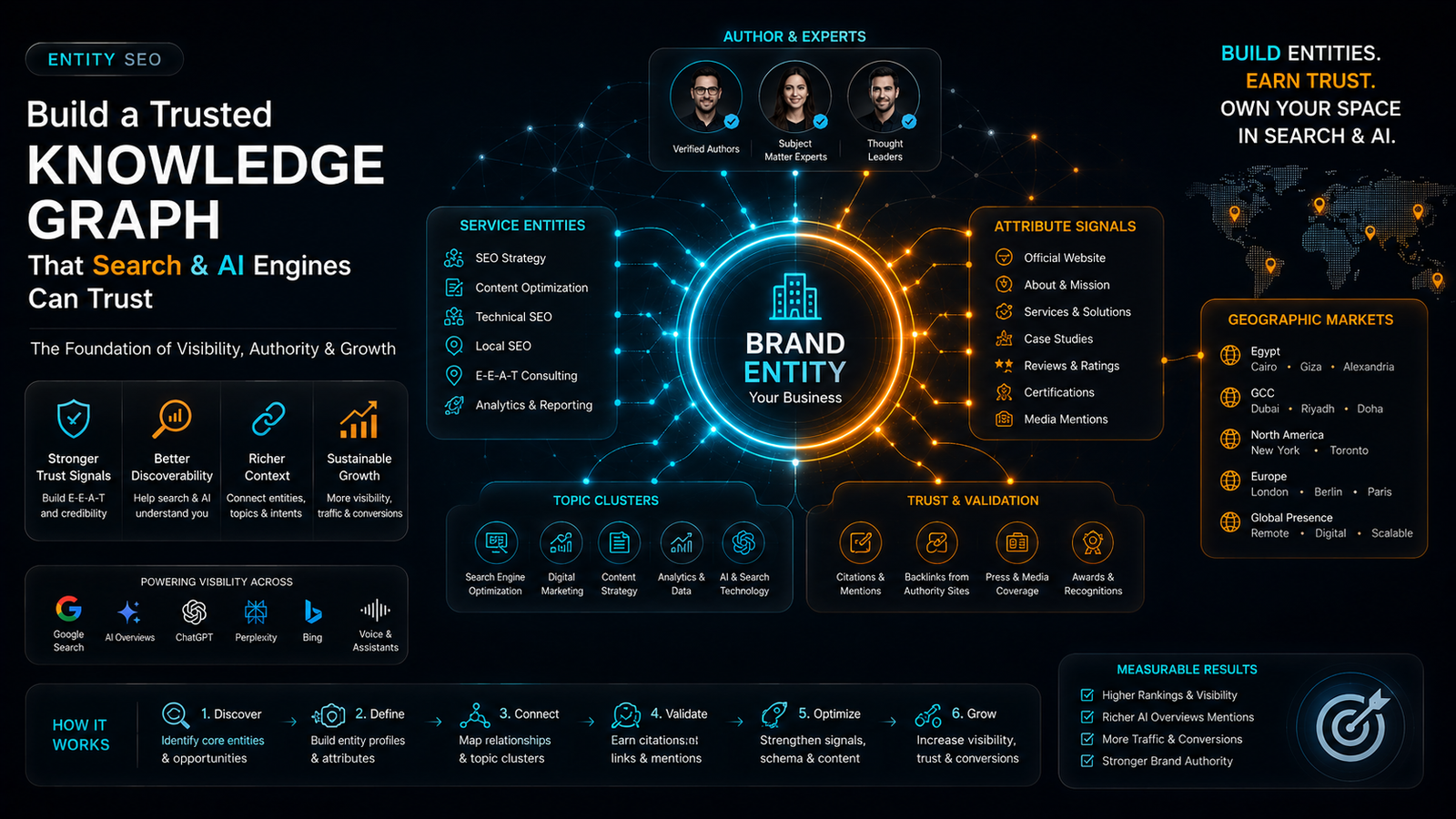
Before expanding a site with more pages, ask a simpler question: can a visitor and a search system understand who the brand is, what it offers and which market it serves? This guide turns that answer into an auditable operating plan.
When a brand appears beside one service on one page and a different market or description on another, adding more keywords may not solve the underlying problem. The site may lack a connected entity story. This article explains how to build that story and how to separate controllable work from outcomes search systems decide.
Want to see where your brand identity and site content disagree? Request an entity audit on WhatsApp: +20 112 326 9452 |
Contents
Definition • Knowledge Graph distinction • Brand identity • Relationships • Evidence • Languages and markets • Ecommerce • Topical content • Measurement • Execution • Mistakes • FAQs
1. What entity SEO actually means
Entity SEO is the work of making a person, company, product or service understandable as one identifiable subject across a website and trusted references. It is more than repeating a brand name. Search systems and people need a stable description of who the brand is, what it does, where it operates, which services belong to it and what evidence supports the claims.
Create an internal identity card with the official name, alternatives, short description, services, markets, contact details and proof sources. Use it as an editorial reference so the home page, service pages and professional profiles stay factually aligned.
2. Why entities matter beyond keywords
A keyword describes what a searcher types; an entity describes the subject behind many related searches. Someone looking for an SEO consultant in Saudi Arabia may ask about experience, industries, languages, deliverables and trust before contacting anyone. Entity work connects those questions to one coherent brand instead of creating a thin page for every wording variation.
Map pre-contact and post-contact questions to pages. When several URLs explain the same service without a meaningful distinction, consolidate them or give each page a clearly different purpose.
3. Entity SEO versus a Knowledge Graph
Entity SEO is the controlled work a business can do: consistent facts, useful pages, clear relationships and verifiable references. A Knowledge Graph is a system’s representation of relationships between entities. A business cannot force a knowledge panel or guarantee inclusion in a graph. It can make the available evidence easier to understand and check.
Separate the objective from the possible outcome. The objective is accurate, connected information; the outcome may be more consistent understanding and visibility. Replace promises of a guaranteed panel with measurable improvements in branded queries, qualified clicks and conversions.
4. Write a precise brand definition
Every brand needs a stable sentence answering who it is, what it provides, for whom and where. It should distinguish the business from a generic agency while staying honest about delivered experience versus planned services. A clear definition can be adapted to different profiles without changing the underlying facts.
Prepare a 20-word line, a 60-word paragraph and a longer professional bio. Validate them with sales and delivery teams, then use the version that fits each channel.
5. Name, identity and profile consistency
Different spellings, old phone numbers or conflicting descriptions create competing signals. Consistency does not mean copying the same paragraph everywhere; it means keeping core facts, identity and links stable while adapting the message to the audience.
Inventory the website, LinkedIn, Google Business Profile, professional directories and social accounts. Record the display name, description, URL and last review date, then correct the most authoritative profiles first.
Need a clear plan instead of disconnected edits? Contact Mohamed Yahia: +20 112 326 9452 |
6. Pages that give the entity structure
The home page introduces the brand, service pages define the work, an about page explains expertise, and case studies show evidence. Articles answer questions and connect topics to commercial solutions. Each page should have a job; otherwise the site becomes a collection of similar promotional paragraphs.
Link definition to service and service to relevant proof. Use descriptive anchor text that tells the visitor what the destination contains instead of relying on generic labels.
7. Relationships between brand, service and market
Search understanding improves when relationships are explicit: a consultant provides a technical audit for an ecommerce store, or supports education companies in Saudi Arabia. The relationship helps the buyer judge fit and gives systems context that can be corroborated across pages.
Use precise sentences explaining who delivers what, for which industry, in which market and with what observable output. Link to the service or evidence page whenever the relationship affects a buying decision.
8. Experience and proof without inflated claims
Entity strength does not come from saying expert repeatedly. It comes from explaining the method, showing permitted work, describing outputs and acknowledging limits. Evidence may include certifications, approved case studies, anonymized tool snapshots or a transparent explanation of how a decision was made.
For every important claim, identify the source, publication permission and date. If an example is illustrative, label it clearly instead of presenting it as a client result.
9. Arabic and English as one entity
Two languages should represent the same business without forcing a literal translation. Search behavior, terminology and examples can differ by market, while the core name, services, locations, contact details and page relationship remain aligned.
Maintain a bilingual glossary for brand name, service names, industries, locations and abbreviations. Check titles, descriptions, links and contact data after every update so each language points to its equivalent page.
10. Local entity signals in Saudi Arabia, UAE and Iraq
Local search connects a brand with geography, service area, opening information and reputation. Adding a city name to a title is not enough. The page should explain whether work is remote or in person, which market it serves and what local problem it understands.
Create a local page only when there is a real offer, audience and useful local detail. Avoid publishing identical city pages that add no information beyond a replaced place name.
Need a clear plan instead of disconnected edits? Contact Mohamed Yahia: +20 112 326 9452 |
11. Entity SEO for ecommerce products
For a store, the entity network includes the retailer, brand, categories, products, manufacturers and attributes. The challenge is keeping names, specifications, images and availability aligned across product pages and commercial platforms. Useful copy explains fit, use cases and limitations instead of copying a supplier description.
Start with the twenty highest-value products or categories. Match names and attributes, add genuine buying questions and monitor pages that frequently change or disappear.
12. Topical content and authority
Topical authority is not a pile of shallow posts. Choose a central subject, cover definitions, implementation, comparisons and mistakes, then connect the topic to the service. Each article should add an insight, evidence or decision path and make the next step obvious.
Build three layers: understanding, implementation and buying decision. Review overlap monthly and merge weak pages that compete with a stronger URL.
13. Links as meaningful relationships
Internal links explain how pages relate; external references let readers verify a definition, standard or claim. Link volume does not build an entity. A useful link moves the reader to the page that answers the next question.
During an editorial review, identify three destinations: the concept page, the proof page and the contact or service page. Remove links that do not help the current task.
14. How to measure entity SEO
There is no single entity-strength score. Track branded query growth, visibility for relevant non-branded queries, qualified clicks to service pages, consistency of brand information and conversions. Compare trends over a meaningful period rather than judging one day or one appearance.
Capture a baseline before changes: queries, URLs, impressions, clicks, conversions and brand mentions. Tag releases by change type and relate movements to publication and technical dates.
15. A seven-stage execution plan
A practical order is: inventory the entity, audit consistency, design page relationships, improve content and proof, strengthen internal and external references, measure, then review. Publishing many new articles before fixing the core definition expands the inconsistency.
Document the entity in week one, repair core pages in week two, review evidence and links in week three, then test a query set. Release changes in controlled groups when possible.
Need a clear plan instead of disconnected edits? Contact Mohamed Yahia: +20 112 326 9452 |
16. When to hire an entity SEO consultant
Bring in a consultant when languages, markets or brand names multiply, when no page clearly represents a service, or when profiles disagree. A professional deliverable is an entity map, prioritized fixes, content architecture and measurement plan, not a promise of a particular panel or ranking.
Ask for a defined scope: pages reviewed, evidence needed, implementation responsibilities and reporting cadence. Request an entity audit from Mohamed Yahia on WhatsApp: +20 112 326 9452
17. Common mistakes that weaken the brand
Changing the name across pages, creating a thin page for every city, copying supplier descriptions, publishing unverified testimonials, hiding contact details and mixing a personal brand with an unrelated company all create ambiguity. Deleting old URLs without a considered replacement can also break relationships.
Use a pre-launch checklist covering name, description, services, markets, author, proof, links, contact and language versions. Test after release because a template can reproduce one mistake across hundreds of URLs.
18. Practical checklist
A visitor should know who you are quickly, find the relevant service from an article, understand your evidence and contact you without friction. You should also be able to measure whether qualified visits become conversations. These are useful completion criteria for entity work.
Sample pages and verify a clear definition, consistent name, industry relationship, proof, service link, contact path, language accuracy and update date. Record decisions and owners so the system survives team changes.
19. Conclusion
Entity SEO is not a replacement for technical SEO or useful content. It is a disciplined way to organize a brand, its pages, its evidence and its relationships. When facts align and pages serve distinct intents, the site becomes easier for people and search systems to interpret. The responsible outcome is a stronger foundation, not a guaranteed visibility claim.
For an SEO or ecommerce business serving Saudi Arabia, the UAE, Iraq or the wider Arab market, begin with an entity assessment before commissioning more content. Contact Mohamed Yahia on WhatsApp: +20 112 326 9452
Pre-publication audit checklist
• Name, description and contact details are consistent on core pages
• Each service has a clear page and a logical internal relationship
• Evidence is publishable and illustrative examples are labelled
• Markets, languages and links are reviewed after updates
• A baseline exists for queries, clicks and conversions
• A short contact path without guarantees or premature pricing
Implementation worksheet
Inventory names
Record the official brand name, short name, products or services and historical spellings. Keep alternatives in the register so you can find pages that need clarification rather than losing useful context.
Assign ownership
Choose one person to approve the brand, service and market descriptions. Without an owner, every writer creates a new definition and inconsistency grows with the site.
Collect evidence
Gather certification links, professional profiles, approved case studies and public references. Tag what each source proves and remove material you do not have permission to publish.
Map relationships
Connect the brand to services, industries, markets and languages. Write one precise sentence for each relationship and identify the page that should explain it.
Review the home page
Can a new visitor understand who you are within seconds? Check title, description, services, markets, proof and contact path. Visual polish should not hide missing information.
Review service pages
For every service, state the problem, scope, deliverables, fit and exclusions. Clear boundaries reduce unqualified enquiries and explain how the service belongs to the brand.
Audit external profiles
Compare name, description, URL and phone number on the strongest profiles. Update old entries and record dates; do not create many low-quality listings to inflate signal volume.
Govern languages
Maintain a bilingual glossary for service terms, locations and abbreviations. Check text direction, city names and equivalent-language links after each release.
Set a baseline
Save branded and commercial query sets, landing pages, qualified visits and conversions. Without a baseline, it is impossible to tell whether a change helped.
Review monthly
Schedule a monthly review of names, links, content and evidence. Check changes to services and markets before they spread to many URLs.
Decide what to merge
When two pages target the same intent, compare quality, links and conversions. Keep the stronger URL, merge useful material and plan the replacement carefully.
Choose the contact step
Once the review is complete, request a prioritized implementation plan. Ask for a scope based on pages, languages and evidence instead of a generic price.
Quick diagnostic questions
Is the name stable?
If the site and profiles disagree, choose the official form and document alternatives and their context.
Is the promise clear?
If a visitor needs several pages to understand the offer, rewrite the core definition and service page.
Is the evidence understandable?
Do not publish a screenshot or testimonial without explaining what it proves and how it relates to the service.
Can the relationship be followed?
When you mention an industry or service, provide a useful page the reader can reach directly.
Are languages equivalent?
Check that the English version does not silently describe a different service or market from the Arabic page.
Is the market specific?
Explain who you serve and where instead of using a broad regional label without an example.
Is measurement ready?
Record the current state before changes so normal volatility is not confused with impact.
Does the CTA fit?
Connect the invitation to the section problem and ask for a scope discussion rather than a generic price.
These questions do not replace an audit, but they give the team a shared starting point before it invests in more content.
Official references
Google Search Central: Site names and identity https://developers.google.com/search/docs/appearance/site-names
Google Search Central: Creating helpful, reliable, people-first content https://developers.google.com/search/docs/fundamentals/creating-helpful-content
Google Knowledge Panel help https://support.google.com/knowledgepanel/answer/7534842
Frequently Asked Questions
Answers to the most common questions about this topic.
01 Is entity SEO a replacement for technical SEO?
No. It is an information and relationship layer built on crawlable pages, useful content and sound technical foundations. Fix blocking technical problems first, then improve the entity model.
02 Can I guarantee a Knowledge Panel?
No responsible consultant can. You can improve consistency and evidence, while search systems decide whether and how a panel appears.
03 Should every city have a page?
Only where there is a genuine offer and useful local information. Near-identical city pages add little value.
04 How do I start?
Inventory the brand name, services, markets and profiles, compare them with core pages, then prioritize repairs before publishing more content.
05 When should I request an audit?
When languages, markets or services multiply and page ownership is unclear. Request an entity audit at +20 112 326 9452.